Accountant Resume
Senior accountant resume with financial reporting, GAAP compliance, audit preparation, and month-end close.
Accounting hiring in 2026 runs on a talent shortage: fewer graduates are sitting for the CPA exam while experienced accountants retire, so qualified candidates often clear screens quickly — but the screens themselves have become more mechanical. ATS filters parse for exact terms: GAAP, month-end close, financial reporting, audit preparation, and the specific systems a company runs (QuickBooks, NetSuite, SAP). Recruiters then apply an accountant-specific credibility check that most resumes fail: process scale and cycle numbers. 'Responsible for month-end close' says nothing; 'own a 5-day close across 3 entities, cut from 9 days' tells a hiring manager your level, your process skill, and your value in one line.
The role itself is also shifting under automation. Software now books routine entries and matches invoices, so employers screen for the judgment layer above it: reconciliation review, accrual estimates, audit-ready documentation, and the systems skills to improve the process rather than just run it. That is why the strongest accounting resumes in the current market pair compliance vocabulary (GAAP, controls, tax deadlines met) with efficiency evidence (days cut from close, hours automated, error rates reduced). The senior accountant example on this page is built on exactly that pairing, and the guide below breaks down how to write your own.
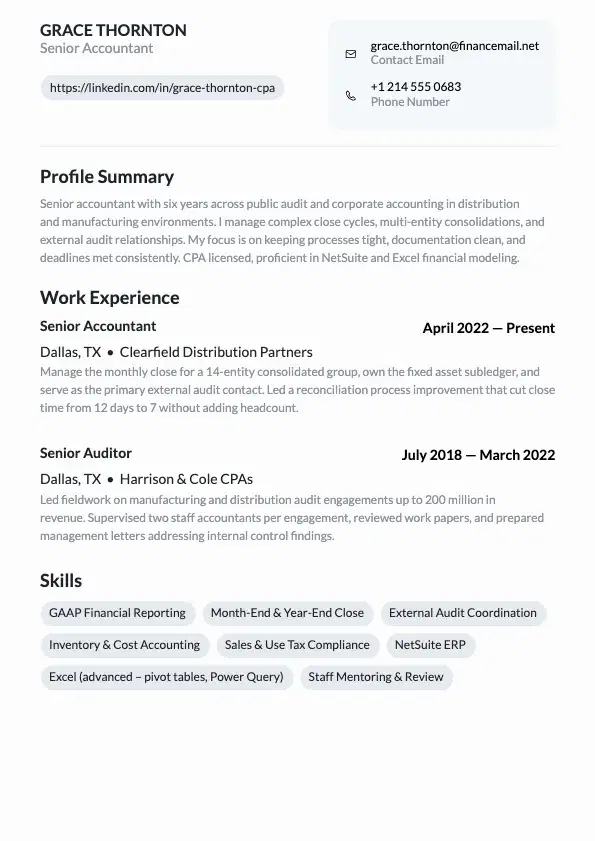
Resume Example
Accountant Resume
Senior accountant resume with financial reporting, GAAP compliance, audit preparation, and month-end close.
Use This SampleCreate from Scratch- ATS-Friendly Format
- Expert-Crafted Content
- Free to Customize
Key Skills Featured in This Example
These competencies appear throughout the resume to pass ATS filters and impress hiring managers.
Why This Resume Works
Compliance keywords are explicit and load-bearing
This example names GAAP, financial reporting, audit preparation, month-end close, and tax compliance — the precise phrases accounting ATS filters and recruiter searches run on — and then anchors each in a bullet where the work happened: statements prepared under GAAP, PBC schedules delivered to external auditors, filing deadlines met across jurisdictions. In accounting, these are not buzzwords; they are the checklist. A resume that says 'financial duties' instead of naming them simply does not surface.
The close cycle is quantified, which instantly levels the candidate
Hiring managers level accountants by the close they run: how many days, how many entities, how much revenue, how many reconciliations. This example states those numbers, and adds the senior-level differentiator — improvement over time, with the close shortened and errors reduced. That single pattern separates a senior accountant who owns a process from a staff accountant who participates in one, and it is the first thing a controller reading the resume looks for.
Systems fluency reads as efficiency, not just software use
QuickBooks and advanced Excel appear in the skills list, but the bullets show them producing outcomes: reconciliations automated, manual entry hours eliminated, reporting packages built. With automation absorbing routine bookkeeping, employers now hire accountants who improve systems rather than merely operate them — and demonstrated process improvement is also the strongest defense a candidate can offer against the perception that accounting work is being automated away.
What Hiring Teams Look For in a Accountant Resume
Ownership of a faster, cleaner close
Example: Own month-end close for 3 entities, cutting the cycle from 9 to 5 business days by standardizing reconciliation templates and automating recurring journal entries.
Close speed with an improvement story is the accounting equivalent of a sales quota number: instantly understood, easily benchmarked, and proof of both technical skill and process ownership. Controllers screening resumes look for this bullet first.
Audit-ready work that survived scrutiny
Example: Prepared PBC schedules and supporting documentation for annual external audits across 2 fiscal years, closing both with zero material adjustments.
'Zero material adjustments' is shorthand for clean books and defensible judgment — the outcome every controller is ultimately accountable for. It also signals you can work with auditors efficiently, which reduces the most stressful weeks of the finance calendar.
Automation or process improvement with hours attached
Example: Built Excel Power Query reconciliation workbooks and QuickBooks bank rules that eliminated roughly 12 hours of manual matching per month and cut posting errors by half.
Efficiency bullets show you scale beyond your own hours and adapt as routine tasks automate. In a market where firms struggle to fill seats, an accountant who reduces the work is worth more than one who just completes it — and screeners increasingly search for exactly this signal.
Compliance record stated as a result
Example: Maintained GAAP-compliant reporting and met 100% of federal, state, and sales tax filing deadlines across 6 jurisdictions for 3 consecutive years.
Accounting is a zero-defect discipline, and a stated on-time, compliant track record converts an assumed baseline into verifiable evidence. It also surfaces jurisdiction complexity — multi-state or multi-entity work — which is a leveling detail managers cannot see from a title alone.
How to Write a Accountant Resume, Step by Step
Use a conservative, single-column format with credentials up top
Accounting is a conservative profession; a clean, traditional layout is a feature, not a limitation. Put licenses beside your name — 'Maria Chen, CPA' — then city and state, phone, email, LinkedIn in plain text. Standard headings, reverse-chronological order, no graphics or tables. Finance recruiters and ATS software both reward predictability; creative templates cost interviews in this field.
Pro tip: If you are CPA-eligible or partway through the exam, say so precisely — 'CPA candidate, 2 of 4 sections passed' — because eligibility is itself a filter many firms search on.
Write a summary that states scope, systems, and compliance frame
Three lines: years of experience, the accounting scope you own (close, reporting, AP/AR, audit support), entity or revenue scale, and your systems. Example: 'Senior accountant with 7 years in multi-entity month-end close and GAAP financial reporting for a $50M distributor; QuickBooks and advanced Excel; cut the close cycle 40% while maintaining a clean audit record.' Name your industry — public accounting, manufacturing, SaaS, nonprofit — because fund accounting and revenue recognition experience are domain filters.
Pro tip: Mirror the posting title exactly in your summary — Staff Accountant, Senior Accountant, and Accounting Manager are distinct database searches, and the wrong label buries you.
Turn responsibilities into scale-and-outcome bullets
Every accountant has the same duty list, so differentiation comes entirely from numbers and improvements. For each role, write 3-6 bullets covering: close ownership (days, entities, reconciliations), reporting (statements, packages, audiences), audit support (schedules, adjustment outcomes), compliance (filings, jurisdictions, deadlines), and process improvement (hours saved, errors cut). Attach a figure to each — transaction volume, revenue scale, cycle time, error reduction.
Pro tip: Convert every "responsible for" phrase into a verb plus a number — "reconciled 25 balance-sheet accounts monthly" beats "responsible for reconciliations" in both parsing and persuasion.
List systems and technical skills with specificity
Group into Accounting and Compliance (GAAP, financial reporting, month-end close, audit preparation, tax compliance, accounts payable/receivable) and Systems (QuickBooks, Excel with pivot tables and Power Query, plus any ERP exposure like NetSuite or SAP). ERP names are heavily filtered in mid-market and enterprise postings, so include real exposure even if partial. Generic "Microsoft Office" wastes a line; specific Excel capabilities do not.
Pro tip: If you have touched an ERP migration or implementation even peripherally, state it — system-transition experience is scarce and disproportionately valued as companies move off entry-level software.
Close with education, licensure, and professional signals
Degree, institution, year, and GPA if above 3.5 and you are within a few years of graduating. Give licensure its own section: CPA with state and year, or exam progress; CMA if held. Note continuing professional education only when it maps to the target role — for example, a revenue recognition or multi-state tax course. Membership in AICPA or a state society earns a line; it signals professional seriousness at zero space cost.
Pro tip: Employers verify CPA status against state boards in minutes, so state your license exactly as registered — and never round "candidate" up to "CPA."
How Much Does a Accountant Make?
Low
$52,780
per year (US)
Median
$81,680
per year (US)
High
$141,420
per year (US)
Pay scales with credentials, industry, and scope: entry-level staff accountants in smaller markets sit near the bottom of the band, while CPAs in finance, tech, and large-enterprise roles — and seniors stepping into accounting manager or controller tracks — populate the top decile. The CPA license is the single largest lever, and multi-entity or public-company reporting experience commands a premium.
Salary data based on U.S. Bureau of Labor Statistics, May 2024 Occupational Employment and Wage Statistics for Accountants and Auditors (10th percentile, median, and 90th percentile annual wages).
Key Takeaways
An accountant resume wins by converting a duty list every candidate shares into evidence only you have: the days in your close, the entities and revenue you cover, the audits that ended clean, the hours your process improvements eliminated. Name the compliance vocabulary filters demand — GAAP, month-end close, audit preparation, tax compliance — and the systems by exact name, keep the format conservative and parseable, and state licensure precisely. In a market short of qualified accountants, a resume with real numbers does not just pass the screen; it moves you to the front of it.
Accountant Resume FAQs
How long should an accountant resume be?
One page for staff and senior accountants under roughly 10 years of experience; two pages for managers and controllers with substantial scope. Accounting recruiters scan for credentials, systems, and close numbers in seconds, so lead with those. Compress roles older than 10 years to a single line each.
Should I put CPA on my resume if I have not passed all exam sections?
Yes, but precisely: "CPA candidate, 2 of 4 sections passed" or "CPA eligible, sitting Q3 2026." Exam progress is a genuine filter many employers search for, and precision signals the integrity the profession demands. Never abbreviate your status to "CPA" before licensure — verification against state boards is routine and fast.
What skills should an accountant list on a resume?
Compliance and process skills first — GAAP, financial reporting, month-end close, audit preparation, tax compliance, accounts payable and receivable — then systems by exact name: QuickBooks, NetSuite or SAP if you have exposure, and Excel with specific capabilities like pivot tables and Power Query. Match the posting vocabulary exactly, because accounting ATS filters run on precise phrases.
How do I quantify accounting work on a resume?
Use the numbers native to the job: close cycle in days, entities and reconciliations owned, revenue or transaction volume supported, audit adjustment outcomes, filing deadlines met across jurisdictions, and hours saved through automation. Improvement deltas — a close cut from 9 to 5 days — are the strongest form. Confidential figures can be expressed as ranges or percentages.
Is QuickBooks experience enough, or do I need ERP skills?
QuickBooks covers small-business and many mid-size roles, but NetSuite, SAP, or Oracle exposure meaningfully widens your market, since mid-market and enterprise postings filter on ERP names. List any genuine ERP exposure, including participation in a migration. If you have none, advanced Excel plus a demonstrated record of learning systems quickly is the honest bridge.
How do I write an accounting resume with no experience?
Lead with education, CPA-exam progress, and relevant coursework, then mine internships, bookkeeping side work, VITA tax volunteering, or treasurer roles in student organizations for real bullets with numbers — transactions processed, reconciliations performed, filings supported. Name the software you used, even in coursework. Employers facing a talent shortage will interview credible entry-level candidates who show precision.
Public accounting vs. industry — how should my resume differ?
Moving from public to industry, translate engagements into operational language: audits performed become audit-preparation insight, and client industries become domain experience. Emphasize close, reporting, and systems exposure over engagement counts. Moving into public accounting, emphasize GAAP rigor, documentation quality, and deadline density. Either way, mirror the target vocabulary, not your current firm.
Will automation and AI hurt accounting careers, and should my resume respond?
Automation is absorbing data entry and matching, not judgment work — accruals, estimates, controls, audit response, and analysis. Your resume should sit deliberately on that judgment side: show that you automated or streamlined routine tasks and spent the recovered time on review and analysis. An accountant who demonstrably improves processes reads as automation-proof.
What certifications matter most on an accountant resume?
CPA is the dominant credential for reporting, audit, and management-track roles, and correlates with significantly higher pay. CMA suits cost and management accounting in industry; EA is specific to tax representation work. QuickBooks or NetSuite certifications are minor but useful keyword signals for entry and mid-level roles. One relevant credential stated precisely beats a list of marginal ones.
How do I tailor an accountant resume for each application?
Match three elements per posting: the exact title in your summary, the compliance phrases the posting uses (close, GAAP, audit, tax), and the systems it names — if it says NetSuite and you have it, that word must appear. Then reorder bullets so your most relevant scope story leads. Tools like Resunote automate the keyword-matching pass, but the scope numbers must come from you.
Turn This Example Into Your Resume
Use this sample as your starting point. Customize it in minutes, export as a PDF, and apply with confidence.