Data Analyst Resume
Strong example for data analysts skilled in SQL, Python, and business intelligence reporting.
Data analyst hiring in 2026 has a paradox at its center: demand for analytical work keeps growing, but the entry-level funnel is crowded with bootcamp graduates and career changers holding near-identical certificate lists. Screeners — human and automated — respond by filtering hard on two things: tool specificity and business impact. An ATS extracts whether you have SQL, Python, Tableau, or Power BI as discrete skills; the recruiter behind it checks whether those tools appear attached to real analyses that changed a decision. 'Analyzed sales data' passes neither test. 'Built a Power BI churn dashboard that redirected $200K of retention spend' passes both.
There is a second shift worth knowing: as AI handles more routine query-writing and chart-building, hiring managers increasingly screen for the judgment layer — experiment design, metric definition, stakeholder communication — that automation does not replace. The strongest analyst resumes in this market read like a portfolio of answered business questions, not a list of tools operated. The example on this page is structured exactly that way, and the sections below unpack why it works and how to replicate it with your own experience.
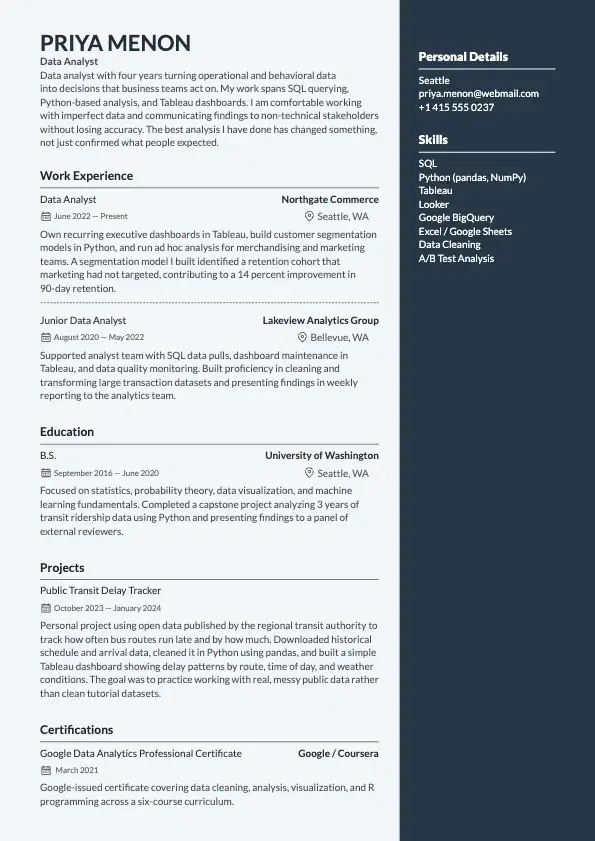
Resume Example
Data Analyst Resume
Strong example for data analysts skilled in SQL, Python, and business intelligence reporting.
Use This SampleCreate from Scratch- ATS-Friendly Format
- Expert-Crafted Content
- Free to Customize
Key Skills Featured in This Example
These competencies appear throughout the resume to pass ATS filters and impress hiring managers.
Why This Resume Works
Every tool is tied to an analysis, not floated in a list
This example lists SQL, Python, Tableau, Power BI, and Excel in its skills section — the exact keywords data analyst postings filter on — but its real strength is that each tool reappears in an experience bullet doing something: SQL joining product and billing data, Pandas cleaning a messy export, Tableau serving a leadership dashboard. Screeners discount orphan keywords; a tool demonstrated inside a shipped analysis is worth several merely listed.
Bullets end in decisions and dollars, not deliverables
The weakest analyst bullets stop at the artifact: 'created dashboards and reports.' This example pushes each bullet one step further to the business outcome — what the analysis changed, saved, or grew. That framing matters because analysts are hired to influence decisions, and a resume that shows a track record of adopted recommendations pre-answers the interview's central question: does this person's work actually get used?
It shows the full pipeline, from raw data to stakeholder
The bullets span ETL work, statistical rigor (A/B testing), visualization, and presentation to non-technical audiences. That range signals a self-sufficient analyst who does not need a data engineer for every extract or a manager to translate findings. For small and mid-size teams — most of the market — end-to-end capability is the difference between a hire and a maybe.
What Hiring Teams Look For in a Data Analyst Resume
SQL depth beyond SELECT statements
Example: Wrote SQL with window functions and CTEs across a 40-table warehouse to build a customer lifetime value model refreshed daily via a scheduled ETL job.
SQL is the single most-tested analyst skill, and screeners look for vocabulary that separates real practitioners from certificate holders — window functions, CTEs, query optimization, warehouse scale. Naming these tells the reviewer your interview will not collapse at the whiteboard.
Analysis that changed a business decision
Example: Identified through cohort analysis that 60% of churn occurred in the first 14 days, leading the product team to rebuild onboarding and cut early churn by a quarter.
The chain — analysis, insight, action, result — is what hiring managers mean by "business impact." A bullet showing your finding was adopted proves influence and communication in one line, which no skills section can do.
Experimentation and statistical literacy
Example: Designed and evaluated 12 A/B tests on pricing-page variants, applying significance testing to prevent two false-positive rollouts that would have cut conversion.
Companies burned by dashboard-only analysts now screen for statistical judgment. Mentioning test design, sample sizing, or significance testing signals you know when a number is real — a skill that AI tooling has made more valuable, not less.
Self-serve reporting that scaled beyond you
Example: Replaced 15 recurring manual reports with a self-serve Power BI workspace used weekly by 40+ stakeholders, freeing roughly 10 analyst-hours per week.
Automating reporting shows leverage: you make the whole team faster, not just yourself. Screeners read this as maturity — junior analysts produce reports; strong analysts eliminate the need for them.
How to Write a Data Analyst Resume, Step by Step
Choose a clean, single-column, ATS-safe format
Header with name, city and state, email, phone, and a LinkedIn URL in plain text; standard headings (Summary, Experience, Skills, Education) in reverse-chronological order. Analysts are sometimes tempted to demonstrate visualization skill through resume design — resist it. Charts, infographics, and two-column layouts break parsing, and the place to show visual skill is a linked portfolio or Tableau Public profile, not the document itself.
Pro tip: If you have a Tableau Public profile or a portfolio site with real dashboards, put the plain-text URL in your header — it is the analyst equivalent of a GitHub link.
Open with a summary that names your domain and toolkit
Three lines: years of experience, the business domain you know (e-commerce, SaaS, healthcare, finance), your core tools, and one headline result. Example: 'Data analyst with 4 years in SaaS, expert in SQL, Python, and Tableau; built the churn-prediction reporting that guided a retention program recovering $1.2M ARR.' Domain keywords matter — many postings filter for industry familiarity as hard as tool skills.
Pro tip: Rewrite the first line of your summary for every application to mirror the posting's exact title — Data Analyst, Business Intelligence Analyst, and Product Analyst are different searches in a recruiting database.
Write experience bullets as question-to-decision stories
For each role, pick 3-6 analyses that mattered and compress each into one bullet: the business question, the method and tools, and the outcome. Quantify at both ends — data scale in (rows, tables, sources) and business result out (revenue, cost, time saved, decisions changed). Bullets that only name deliverables (dashboards, reports) without consequences read as junior regardless of your title.
Pro tip: Keep a running 'impact log' of every analysis whose recommendation got adopted — most analysts lose their best resume material because they never wrote down the outcome.
Build a skills section that survives keyword filters
Group by category: Languages and Querying (SQL, Python, Pandas), BI and Visualization (Tableau, Power BI, Excel), Analytics (A/B testing, statistics, ETL, data modeling). Include both tools from your history and the specific names in your target postings when you genuinely have them — a posting asking for Power BI will not match a resume that only says "BI tools." Never list tools you cannot demo; analyst interviews test them live.
Pro tip: List Excel even if it feels basic — a large share of analyst postings still filter on it, and advanced Excel (pivot tables, Power Query, VBA) remains a differentiator in finance-adjacent roles.
Finish with education, certifications, and projects that show real data work
Degree, institution, year; add relevant coursework only if you are within two years of graduating. Certifications (Google Data Analytics, Tableau, Microsoft PL-300) help ATS matching but do not replace demonstrated work — pair every certificate with a project that used the skill on messy, real-world data. Career changers should include a short Projects section with one quantified line per project and a link to the code or dashboard.
Pro tip: Projects using scraped or public-API data you cleaned yourself impress far more than Kaggle-clean datasets — data cleaning is most of the actual job, so show you have done it.
How Much Does a Data Analyst Make?
Low
$72,183
per year (US)
Median
$93,406
per year (US)
High
$122,027
per year (US)
Pay varies chiefly with seniority, industry, and technical depth: entry-level analysts start well below this band, while senior analysts in financial services and tech — especially those with strong Python and experimentation skills — reach the top of it, with 90th-percentile earners reported around $154,000. Analysts who move toward analytics engineering or data science typically price higher still.
Salary data based on Glassdoor U.S. Data Analyst salary estimates (25th percentile, average, and 75th percentile base pay), 2025-2026.
Key Takeaways
A data analyst resume succeeds when it reads as a record of business questions answered, not software operated. Name the tools screeners filter on — SQL, Python, Tableau, Power BI, Excel — but attach each to an analysis with a measurable consequence, quantify both the data scale you handled and the outcome you drove, and keep the format ruthlessly parseable. In a market crowded with identical certificate lists, the analysts who get interviews are the ones whose resumes prove the one thing certificates cannot: that their work changed what the business did.
Data Analyst Resume FAQs
How long should a data analyst resume be?
One page for most analysts; two pages only past roughly 10 years or for hybrid analyst-manager roles. Screeners decide in under a minute, so a single page of quantified analysis bullets beats two pages of report inventories. Trim tool lists and old roles before cutting impact bullets.
What skills should a data analyst put on a resume?
SQL first — it appears in the vast majority of postings — then Python (with Pandas), a BI tool (Tableau or Power BI), Excel, and analytical methods like A/B testing, ETL, and statistics. Group them by category and make sure each also appears in an experience or project bullet. List only skills you can demonstrate live in an interview.
Do I need Python to get a data analyst job?
Not for every role — plenty of analyst positions run on SQL, Excel, and a BI tool — but Python widens your market meaningfully and is increasingly expected for senior and product-analytics roles. If you know Pandas, say so explicitly; it is a distinct keyword filters look for. If you are learning, a real project bullet beats a course certificate.
Should a data analyst resume include a portfolio link?
Yes — a Tableau Public profile, GitHub repo, or portfolio site with two or three real analyses is the strongest differentiator available to early-career analysts. Put the URL in plain text in your header. Quality matters more than volume: one end-to-end analysis of messy real-world data outweighs five polished-dataset exercises.
How do I write a data analyst resume with no experience?
Lead with projects instead of employment: two or three analyses on real data, each with a one-line result and a link. Reframe prior jobs around their analytical fragments — any reporting, Excel modeling, or metrics work counts. Add relevant certifications for keyword coverage, but treat them as supporting evidence, never the headline.
How do I quantify data analyst work on a resume?
Quantify both directions: the data in (sources joined, row volume, reports automated) and the business out (revenue influenced, cost saved, hours freed, decisions changed). If exact figures are confidential, use percentages or honest approximations. The one bullet type to avoid is the unquantified deliverable — "created dashboards" tells a screener nothing.
Data analyst vs. business analyst resume — what is the difference?
A data analyst resume leads with technical depth — SQL, Python, statistical methods, BI tooling — while a business analyst resume leads with requirements gathering, process mapping, and stakeholder work. If you are applying to both, keep two versions with reordered summaries and skills rather than one hybrid that matches neither filter well.
Are certifications like Google Data Analytics worth putting on a resume?
Yes for ATS keyword matching and for showing initiative as a career changer, but they carry little weight on their own because they are extremely common. Always pair a certification with a project that applied it to real, messy data. For experienced analysts, results from actual work make most certificates unnecessary.
How do I tailor a data analyst resume for a specific job posting?
Mirror the posting three ways: use its exact job title in your summary, ensure every required tool you have appears verbatim in your skills section, and reorder your bullets so the most relevant analyses come first. This takes about 15 minutes per application and measurably improves both ATS ranking and recruiter skim results.
Will AI replace data analysts, and should my resume address it?
AI is automating query-writing and chart production, not the judgment layer — defining metrics, designing experiments, and translating findings for decision-makers. Your resume should emphasize exactly that layer: adopted recommendations, experiment design, stakeholder-facing work. A bullet noting you used AI tooling to accelerate analysis reads as adaptability, not obsolescence.
Turn This Example Into Your Resume
Use this sample as your starting point. Customize it in minutes, export as a PDF, and apply with confidence.