Elementary Teacher Resume
Grade 3 teacher resume with differentiated instruction, classroom management, and parent engagement.
Elementary teacher hiring runs through district-level applicant systems, most commonly Frontline (formerly AppliTrack), TalentEd, and state consortium portals, and those systems screen on credentials before content: state certification type, grade-band endorsements, and often a required transcript upload. In 2026, districts facing persistent shortages in some regions and surpluses in desirable suburban districts are triaging harder on two things: evidence of student outcomes and evidence you can manage a real classroom. Principals, who usually make the final call, spend their short review looking for grade levels taught, measurable growth in reading and math, and concrete classroom-management practice, not philosophy-of-education language.
The market has also shifted toward specifics that barely appeared on teacher resumes a decade ago. Science of reading training, MTSS and RTI tier experience, IEP and 504 collaboration, and fluency with platforms like Google Classroom are now screening criteria in many districts, because they map directly to state literacy mandates and inclusion requirements. A Grade 3 teacher who writes that 82 percent of students met their reading growth target says more in one line than a paragraph about fostering a love of learning. The resumes that win interviews treat teaching as a results-and-evidence profession and leave the mission statement for the cover letter.
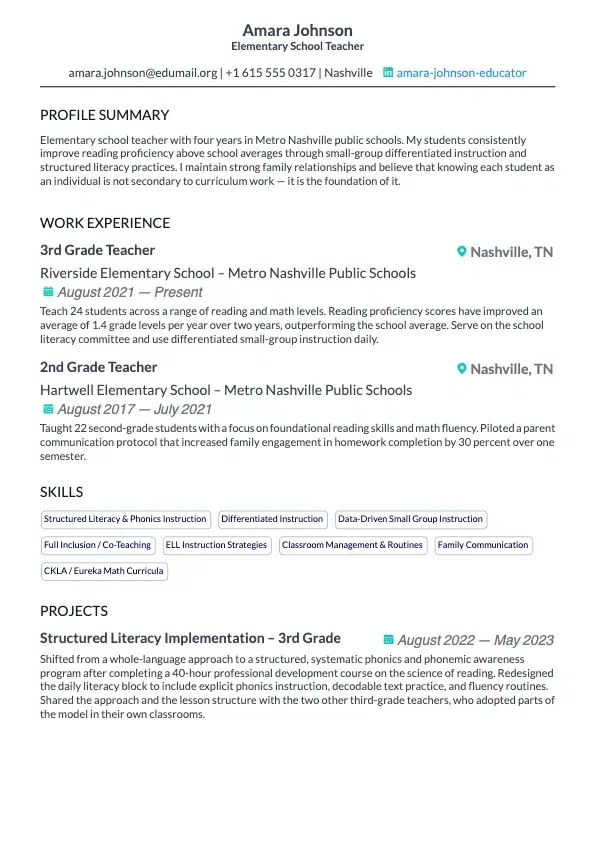
Resume Example
Elementary Teacher Resume
Grade 3 teacher resume with differentiated instruction, classroom management, and parent engagement.
Use This SampleCreate from Scratch- ATS-Friendly Format
- Expert-Crafted Content
- Free to Customize
Key Skills Featured in This Example
These competencies appear throughout the resume to pass ATS filters and impress hiring managers.
Why This Resume Works
It grounds everything in a specific grade and classroom reality
The sample is anchored to Grade 3, which immediately tells a principal the candidate knows the high-stakes context of that year: it is the state-testing entry point and the make-or-break window for reading proficiency. Instead of generic teaching claims, the resume covers differentiated instruction, classroom management, and parent engagement, the three competencies elementary principals probe hardest in interviews. That alignment means the resume answers the interview questions before they are asked.
The skills list mirrors district screening vocabulary
Classroom management, differentiated instruction, IEP collaboration, parent communication, literacy, lesson planning, and Google Classroom are the exact phrases that appear in elementary postings and that district ATS filters and principals scan for. IEP collaboration in particular signals the candidate can operate in inclusion classrooms and contribute to special education compliance, which is a legal obligation districts cannot staff around. Covering these terms both in the skills section and in context keeps the resume visible in keyword searches.
It balances instruction with the operational side of teaching
Strong elementary resumes show more than lesson delivery, and this sample does: parent communication and classroom management sit alongside differentiated instruction and lesson planning. Principals read that combination as a teacher who can run the whole job, including the conferences, the behavior systems, and the documentation, without leaning on administrators. That reduces perceived risk, which is the real currency in teacher hiring, especially for early-career candidates.
What Hiring Teams Look For in a Elementary Teacher Resume
Measured student growth, stated plainly
Example: Raised the share of students reading at or above grade level from 58 percent to 81 percent over one school year, as an example, using small-group instruction informed by i-Ready and DIBELS data.
Districts are accountable for growth scores, and principals shortlist teachers who already talk in those terms. A single before-and-after number with the assessment named outranks any amount of pedagogy language, because it shows you measure your own impact the way the district will measure it.
Differentiation with a visible mechanism
Example: Planned daily tiered lessons across three readiness groups in math and reading, adjusting groupings every two weeks based on formative assessment data.
Every candidate claims differentiated instruction; almost none explain how they do it. Naming the mechanism, such as tiered groups, rotation schedules, and data-driven regrouping, proves the practice is real and gives interviewers something concrete to dig into.
Special education and MTSS collaboration
Example: Implemented accommodations for 6 students with IEPs and 504 plans in an inclusion classroom, co-planning weekly with the special education teacher and documenting Tier 2 interventions for MTSS review.
IEP compliance is a legal requirement, and inclusion classrooms are now the norm. Teachers who show fluency with accommodations, co-planning, and intervention documentation remove a compliance worry from the principal’s desk.
Structured family communication
Example: Sent weekly classroom newsletters through Google Classroom and ClassDojo and held goal-setting conferences with over 90 percent of families each semester, as an example.
Parent complaints are one of the largest drains on a principal’s time. Evidence of proactive, systematic communication, with a cadence and a platform named, signals a teacher who prevents escalations rather than generating them.
How to Write a Elementary Teacher Resume, Step by Step
Lead with your certification and format for district portals
Put your state teaching license directly under your name: state, certificate type, grade band, and endorsements, for example Texas Standard Certificate, Core Subjects EC-6, ESL Supplemental. District systems and principals check certification fit before anything else, and endorsements like ESL, bilingual, or reading specialist widen the requisitions you match. Use a clean single-column layout with standard headings, since Frontline and TalentEd parse uploads into structured fields and mangle multi-column designs.
Pro tip: If your certification is in progress or you are moving states, state the exact status and expected date, for example reciprocity application submitted, eligible for provisional certificate. Vague status reads as a compliance risk.
Write a summary that names grade levels, years, and one proof point
Three lines maximum: grade levels and years taught, your instructional strength, and one measurable outcome. For example: Elementary teacher with 5 years in Grades 2 and 3, specializing in small-group literacy instruction grounded in science of reading practice; raised reading proficiency 20 points in the most recent school year. Skip mission statements about shaping young minds; principals read hundreds of them and they carry zero screening weight.
Pro tip: Mirror the district’s language. If the posting emphasizes structured literacy or PBIS, use those exact terms in your summary when they honestly describe your practice.
Turn classroom duties into outcome bullets
For each position, give the school, grade level, and class size, then 4 to 6 bullets spanning instruction, assessment, management, and collaboration. Convert duties into evidence: not taught reading but moved a named metric; not managed behavior but implemented a PBIS-aligned system that cut office referrals; not communicated with parents but ran a documented conference and newsletter cadence. Include curriculum and assessment names such as Eureka Math, Wonders, DIBELS, or i-Ready, because they tell principals how much retraining you will need.
Pro tip: Student teaching counts as experience for new grads. List it like a job, with grade, school, and outcome bullets, including any full-takeover weeks.
Build a skills section around searchable teaching terms
Include the competencies districts filter on: classroom management, differentiated instruction, lesson planning, IEP and 504 collaboration, literacy or structured literacy, formative assessment, and platforms like Google Classroom, Seesaw, or ClassDojo. Keep it to roughly 8 to 12 terms that you can defend with a story in an interview. Leave out generic entries like communication and teamwork; they are assumed and they crowd out terms that actually match posting language.
Pro tip: Add MTSS or RTI if you have documented intervention experience. It is one of the most searched terms in current elementary postings and few candidates include it.
Close with education, certifications, and professional development that signals currency
List your degree and institution, your certification details if not already in the header, and then targeted professional development: science of reading or LETRS training, trauma-informed practice, SIOP or ESL methods, and technology certifications like Google Certified Educator. Recent, named PD tells districts you are current with the instructional shifts they are funding. Committee work, club sponsorship, or curriculum-writing roles belong here too, since they show you contribute beyond your own classroom.
Pro tip: LETRS or equivalent science of reading training is worth its own line. Many states now mandate it, and having it done makes you cheaper and faster to onboard.
How Much Does a Elementary Teacher Make?
Low
$46,440
per year (US)
Median
$62,340
per year (US)
High
$102,010
per year (US)
Teacher pay is set by district salary schedules, so the range is driven by state and district funding, years of service, and education level, with a master’s degree typically moving you to a higher lane. High-cost states like New York and California, plus stipends for ESL or special education endorsements and extracurricular duties, account for most of the top of the range.
Salary data based on U.S. Bureau of Labor Statistics, May 2024 Occupational Employment and Wage Statistics for Elementary School Teachers, Except Special Education; low and high reflect the 10th and 90th percentile annual wages.
Key Takeaways
An elementary teacher resume gets interviews when it proves certification fit instantly, anchors every claim to a grade level and a classroom, and quantifies student growth with the assessment named. Show the mechanism behind differentiated instruction, document your IEP and MTSS collaboration, and present parent communication as a system with a cadence rather than a virtue. Keep the format plain for district portals, mirror each posting’s vocabulary in your summary and skills, and let measurable outcomes, not mission statements, carry the argument that you can run a classroom principals never have to worry about.
Elementary Teacher Resume FAQs
Should I put my teaching certification on my resume?
Yes, near the top, with the state, certificate type, grade band, and endorsements, for example Illinois Professional Educator License, Elementary Education 1-6, ESL endorsement. Certification fit is the first thing district screeners and principals verify, and making them hunt for it costs you time in the queue. If you are certified in multiple states, list each.
How do I write a teacher resume with no experience?
Treat student teaching as your primary experience: list the school, grade, and duration, and write outcome bullets about lessons you planned, groups you differentiated, assessments you used, and your full-takeover period. Add practicum placements, substitute or paraprofessional work, tutoring, and camp or after-school leadership. Lead with your certification and any endorsements, since eligibility is your strongest asset before your first contract.
How long should an elementary teacher resume be?
One page for new and early-career teachers, and up to two pages once you have a decade of experience, curriculum leadership, or committee work worth showing. Principals skim quickly, so structure matters more than length: clear headings, grade levels visible for every role, and outcomes in the first bullet of each position.
Should I include student test scores or growth data on my resume?
Yes, if you present them accurately and name the assessment, for example moved median i-Ready reading growth from the 40th to the 65th percentile. Districts are evaluated on growth data, so principals respond strongly to candidates who report their own. Use class-level or percentage figures rather than anything that could identify individual students.
Do principals actually read resumes, or just the district application?
Both, but at different stages. District HR systems screen the structured application for certification and requirements, then principals read the resume itself when building interview lists. That means your resume must survive keyword screening and impress a human skimmer, so mirror posting language while keeping bullets specific and readable.
Should I mention classroom management strategies by name?
Yes. Naming a framework such as PBIS, Responsive Classroom, or restorative practices, plus one result like reduced office referrals, is far more convincing than the phrase strong classroom management. Principals interview heavily on management, and a named system tells them your approach will mesh with the school’s existing model.
How do I show IEP experience if I am not a special education teacher?
Describe your role in the inclusion process: implementing accommodations and modifications, collecting progress data, attending IEP meetings, and co-planning with special education staff. A bullet like implemented accommodations for six students with IEPs and 504 plans and contributed teacher input to annual reviews shows legal and practical fluency. General education teachers with documented IEP collaboration are noticeably easier to place, so never leave it off.
Is it worth listing technology like Google Classroom on a teacher resume?
Yes, list the platforms you actually use: Google Classroom, Seesaw, ClassDojo, i-Ready, or your district equivalents. Elementary postings increasingly name specific platforms, and screeners search for them. A Google Certified Educator credential is worth including too, since it verifies the skill rather than merely claiming it.
Should my teacher resume include a photo or creative design?
No. District application systems parse resumes into text, and photos, decorative columns, and graphics either break parsing or get stripped out. Some districts also discourage photos for bias-in-hiring reasons. A clean, single-column layout with standard fonts communicates professionalism and survives every portal.
How should I tailor my resume for each district?
Adjust the summary and skills section to mirror each posting: the grade band, the curriculum or literacy framework named, and priorities like MTSS, PBIS, or dual language. Districts phrase requirements differently, and matching their exact wording improves both ATS visibility and principal recognition. Keeping a master resume and adapting those two sections per application takes minutes and measurably raises response rates.
Turn This Example Into Your Resume
Use this sample as your starting point. Customize it in minutes, export as a PDF, and apply with confidence.