Graphic Designer Resume
Graphic designer resume featuring print and digital design, brand systems, and client presentation skills.
Graphic designer resumes face a screening paradox: the resume itself is a design artifact, but it must first survive software that cannot see design. In 2026, most in-house and agency roles route applications through ATS platforms that parse text only, so the elaborate two-column, icon-heavy resumes designers instinctively build often arrive as scrambled fragments. The working standard now is a two-document strategy: a cleanly typeset, parseable resume that demonstrates typographic judgment through restraint, paired with a portfolio link that carries the visual argument. Creative directors reviewing candidates spend their first seconds on the portfolio link and the most recent role, and no amount of resume decoration compensates for a weak or missing portfolio URL.
The market has also repriced the skill set. Generative AI has commoditized fast production work, pushing hiring value toward what it cannot replicate: brand system thinking, art direction, print production knowledge, and the client-facing judgment to present and defend work. Postings increasingly ask for hybrid range, Adobe Creative Suite plus Figma, print plus digital, execution plus presentation, because teams are smaller and each designer covers more surface. A resume that positions you as a systems-level designer who ships across media and communicates with stakeholders reads as current; one that lists software and nothing else reads as replaceable, and screeners in this field are unusually attuned to that difference.
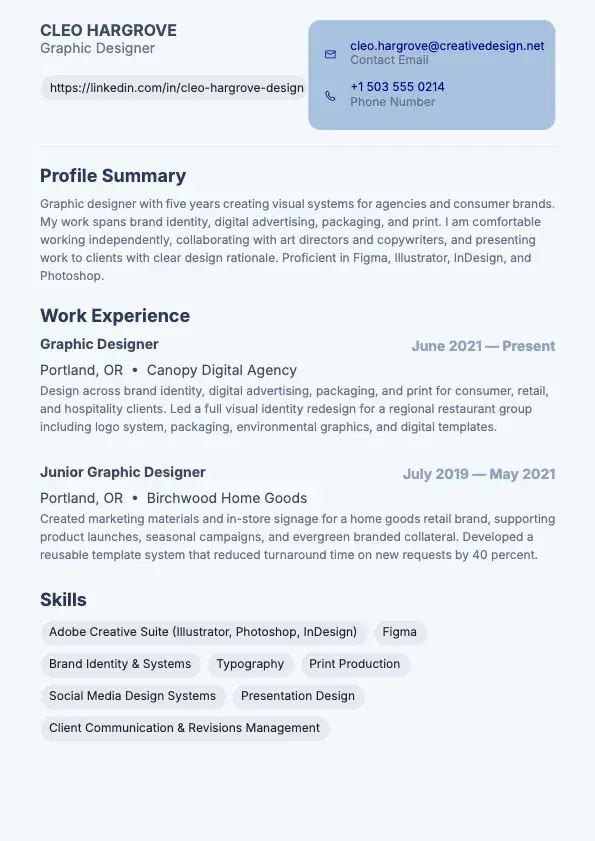
Resume Example
Graphic Designer Resume
Graphic designer resume featuring print and digital design, brand systems, and client presentation skills.
Use This SampleCreate from Scratch- ATS-Friendly Format
- Expert-Crafted Content
- Free to Customize
Key Skills Featured in This Example
These competencies appear throughout the resume to pass ATS filters and impress hiring managers.
Why This Resume Works
It covers the print-plus-digital range teams now require
The sample spans print design, digital work, and layout, with InDesign alongside Figma, which mirrors how design roles are actually scoped in 2026: fewer specialists, more designers who can take a brand from a trade-show banner to a product UI asset. Print production competence in particular has become a differentiator, since a generation of digital-only designers cannot prep files for press. Showing both ranges keeps the resume eligible for the widest set of postings and signals versatility without claiming everything.
Brand systems framing elevates it above production work
Leading with brand systems rather than individual deliverables positions the candidate as someone who designs the rules, not just the artifacts: logo systems, typography hierarchies, color standards, and templates other people can execute against. This is precisely the skill layer that AI production tools have not commoditized, and it is what separates mid-level designers from junior ones in hiring conversations. It also implies consistency and governance thinking, which in-house teams managing sprawling brand touchpoints value highly.
Client presentation skills signal a designer who can defend work
Including client presentation alongside the craft skills addresses the question every creative director asks about a portfolio they like: can this person walk a client through the reasoning and handle pushback? Designers who present well reduce revision cycles, protect the work, and can be put in front of stakeholders unsupervised. Naming that capability, backed by tools like typography and layout fluency that make the reasoning credible, makes the sample read as a senior-track hire rather than a production resource.
What Hiring Teams Look For in a Graphic Designer Resume
A prominent, curated portfolio link
Example: Portfolio: janedoe.design, 10 selected projects spanning brand identity, packaging, and digital campaigns, each with a short case study covering the brief, process, and outcome.
The portfolio is the actual hiring document; the resume exists to deliver it and contextualize it. A named, working URL in the header with case-study framing tells reviewers you understand that, and a resume without one is discarded in most creative screens regardless of experience.
Business outcomes attached to design work
Example: Redesigned the packaging system for a regional beverage line, contributing to an example 25 percent lift in shelf sales in the first two quarters after launch, per the client’s reporting.
Most designers describe deliverables; few connect them to results. Even one or two outcome-linked bullets, sales lift, engagement improvement, conversion gains, reframe design as a business investment and separate you sharply in a stack of software-list resumes.
Brand system ownership, not just asset production
Example: Built and documented a full brand system, logo suite, type hierarchy, color standards, and 40+ templates, adopted across an example footprint of 12 franchise locations with no design staff on site.
Template and guideline work proves you design for scale and for other hands, which is what in-house teams and agencies both need as brands multiply across channels. It signals mid-to-senior judgment that pure production experience cannot.
Cross-medium production fluency
Example: Delivered campaigns end to end across print and digital, prepress-ready InDesign files with correct bleed and color profiles, plus Figma-based social and web assets, coordinating directly with print vendors on proofs.
File-preparation competence is where inexperienced designers fail expensively, so naming prepress specifics and vendor coordination de-risks the hire. Pairing it with Figma fluency shows you bridge the print and product worlds most teams now straddle.
How to Write a Graphic Designer Resume, Step by Step
Design the resume for parsing first, taste second
Use a single-column layout, one or two well-chosen typefaces, generous white space, and standard section headings; let typographic hierarchy, not decoration, show your eye. ATS parsers scramble multi-column layouts, icons, and infographics, and creative directors read restraint as confidence. Put your portfolio URL in the header next to your email, styled so it cannot be missed, and make sure the link works without a password.
Pro tip: Export a text-only version of your resume and read it. Whatever the plain text scrambles is what the ATS sees, so fix the layout until the text version reads in order.
Write a summary that states your design identity and range
Two to three lines: years of experience, your center of gravity such as brand identity or packaging, your range across print and digital, and one credibility marker like a notable client category or a measurable result. For example: Graphic designer with 6 years across brand systems, packaging, and digital campaigns for retail and hospitality clients; work contributed to a 25 percent shelf-sales lift on a flagship packaging redesign. Avoid passionate and creative as self-descriptions; the portfolio either proves them or it does not.
Pro tip: Match the summary to the role type. Agency postings reward multi-client pace and range; in-house postings reward brand stewardship and cross-team collaboration. Same history, different emphasis.
Build experience bullets around projects, scale, and outcomes
For each role, write 4 to 6 bullets that name project types, brand identities, packaging, campaign systems, editorial layouts, with concrete scale: number of deliverables, clients served, templates built, or locations covered. Attach outcomes where they exist, sales, engagement, adoption, and process contributions where they do not, such as cutting revision rounds by presenting moodboards earlier. Name collaboration explicitly: briefing with account teams, coordinating print vendors, presenting to clients. Freelancers should consolidate client work under one heading with the strongest engagements broken out.
Pro tip: Mirror your resume bullets to your portfolio case studies. When an interviewer can open the exact project a bullet describes, the resume and portfolio reinforce each other instead of competing.
List tools and craft skills the way postings phrase them
Name the software exactly: Adobe Illustrator, Photoshop, InDesign, and Figma, rather than the vague Adobe Creative Suite alone, because ATS matching is literal and many postings list the individual applications. Then add the craft and process skills that differentiate you: typography, layout, brand systems, print production and prepress, and client presentation. Motion basics in After Effects, if you have them, are worth a line, since hybrid static-plus-motion demand keeps growing. Cap the list near a dozen items you can defend in a portfolio walkthrough.
Pro tip: If you use AI tools in your workflow, frame the judgment, not the tool: for example, AI-assisted concept exploration refined through original illustration and type. Tool lists without framing invite the wrong conclusion.
Finish with education, recognition, and proof of craft
List your degree and school briefly; a BFA helps but portfolios outrank pedigrees in this field, and strong self-taught designers win roles on work alone. Add design awards, published or featured work, exhibitions, and relevant certifications or coursework such as advanced typography or print production training. If you have taught, mentored, or led critiques, include it, since it signals the articulation skills that client presentation requires. Keep this section tight; its job is credibility, not length.
Pro tip: Even small recognition, a local ADDY, a feature on a design blog, a packaging design showcase, functions as third-party validation of taste, which is the hardest quality for a resume to prove on its own.
How Much Does a Graphic Designer Make?
Low
$37,600
per year (US)
Median
$61,300
per year (US)
High
$103,030
per year (US)
Pay tracks specialization and setting: in-house designers at large tech, pharmaceutical, and financial firms out-earn agency and studio peers, and brand systems, packaging, and motion-capable hybrid designers command the premium end. Major metros like New York, San Francisco, and Seattle sit well above the national figures, while freelance income varies with client mix and day rates.
Salary data based on U.S. Bureau of Labor Statistics, May 2024 Occupational Employment and Wage Statistics for Graphic Designers; low and high reflect the 10th and 90th percentile annual wages.
Key Takeaways
A graphic designer resume works when it accepts its real job: get parsed cleanly, deliver the portfolio link, and give the reviewer reasons to open it. Show restraint in the resume’s own typography, name your tools individually for the ATS, and frame your experience around brand systems, cross-medium production, and client presentation, the skill layers that survive AI-driven commoditization. Attach business outcomes to your strongest projects, quantify scale everywhere you can, and keep the resume and portfolio telling the same story, because in creative hiring the resume opens the door and the work walks through it.
Graphic Designer Resume FAQs
Should a graphic designer resume link a portfolio?
Yes, always, in the header next to your contact details, as a short clean URL that works without a password. The portfolio is the primary hiring document in design; most creative reviewers will not shortlist a candidate they cannot see work from. Curate it to roughly 8 to 12 strong projects with brief case-study context rather than linking an exhaustive archive.
Should my graphic design resume be creative or simple?
Simple, with excellent typography. ATS software scrambles multi-column, graphic-heavy layouts, and creative directors consistently read restrained, well-set resumes as evidence of mature judgment, saving the visual proof for the portfolio. Demonstrate skill through type choice, hierarchy, and spacing, not through decoration.
Do I need a design degree to get hired as a graphic designer?
No; the portfolio outweighs the credential at almost every employer. A BFA or similar degree helps with some corporate HR filters and provides formal training in typography and theory, but self-taught designers with strong, well-documented work win roles routinely. If you lack the degree, compensate with a rigorous portfolio, named coursework or certifications, and any recognition or published work.
How do I quantify graphic design work on a resume?
Use scale and outcome numbers: deliverables produced, clients or brands served, templates created, campaign assets shipped, and results where measurable, such as engagement lifts, conversion improvements, or sales gains after a redesign, cited from client or team reporting. Process metrics count too, like reduced revision rounds or faster turnaround after building a template system. Even approximate, honestly framed figures beat purely descriptive bullets.
Should I list Figma on a graphic designer resume, or is that just for UX?
List it if you use it. Figma has spread well beyond product design into social assets, presentations, and collaborative brand work, and many graphic design postings now name it alongside the Adobe apps. Showing both Adobe Creative Suite depth and Figma fluency positions you for the hybrid brand-plus-digital roles that dominate current openings.
How should a freelance graphic designer present experience on a resume?
Consolidate freelance work under a single heading, for example Independent Graphic Designer with your operating dates, then break out 2 to 4 of the strongest client engagements as sub-entries with project type, scope, and outcomes. This reads as a coherent practice rather than fragmented gigs. Name client industries even when NDAs prevent naming clients, and mirror the highlighted engagements in your portfolio.
Will AI replace graphic designers, and how should my resume address it?
AI has absorbed much of the fast production layer, but demand has shifted toward what it does poorly: coherent brand systems, art direction, print production accuracy, and client-facing judgment. Your resume should emphasize exactly those layers and can note AI-assisted workflows as an efficiency skill under your direction. Designers positioned as systems thinkers and presenters are screening better in 2026, while production-only resumes are the ones under pressure.
What is the difference between a graphic designer and UX designer resume?
A graphic designer resume centers visual communication, brand systems, typography, print and campaign work, with Adobe tools prominent; a UX resume centers research, wireframing, prototyping, and usability outcomes, with Figma-based product workflows prominent. If you straddle both, lead with the identity matching the posting and keep the other as supporting range. Blurring them fully weakens both stories, since hiring managers screen for role clarity.
How long should a graphic designer resume be?
One page for most designers, since the portfolio carries the depth a second page would try to. Two pages are defensible only for long careers with substantial art direction, team leadership, or notable client rosters. Whatever the length, the top third must contain your portfolio link, your specialty, and your strongest proof point.
Should I tailor my design resume for in-house versus agency roles?
Yes, in emphasis if not in facts. Agency screeners want multi-client range, pace, and pitch or presentation experience; in-house teams want brand stewardship, cross-functional collaboration, and system-building that keeps a single brand coherent across channels. Adjust your summary, bullet order, and highlighted portfolio pieces accordingly, and mirror each posting’s tool and skill wording for the ATS pass.
Turn This Example Into Your Resume
Use this sample as your starting point. Customize it in minutes, export as a PDF, and apply with confidence.