Marketing Manager Resume
Marketing manager resume featuring campaign management, brand strategy, paid media, and team leadership.
Marketing manager resumes are judged by people who evaluate messaging for a living, which makes this one of the least forgiving screening environments in hiring. In 2026, recruiters and CMOs skim for three things in the first pass: revenue or pipeline numbers, channel depth across paid and owned media, and evidence of managing people and budgets. The bar has moved decisively from activity to attribution: launched campaigns is ignored, while grew qualified pipeline 40 percent on flat spend gets a second read. ATS platforms like Greenhouse and Lever do the first cut on keywords, but the real filter is a hiring manager asking one question of every bullet: did this person move a metric that mattered, and can they prove it?
Two market shifts define the current cycle. First, AI has commoditized content production, so differentiation has migrated to strategy, budget efficiency, and measurement: candidates who speak fluently about CAC, ROAS, LTV, and marketing-sourced revenue outrank those who list channels. Second, privacy changes and the erosion of third-party tracking have made first-party data, email and lifecycle marketing, and clean attribution modeling premium skills. A marketing manager resume that names its stack, such as HubSpot, GA4, Google Ads, and Meta Ads, and ties each channel to a business outcome reads as current; one that lists social media marketing and brand awareness without numbers reads as five years out of date.
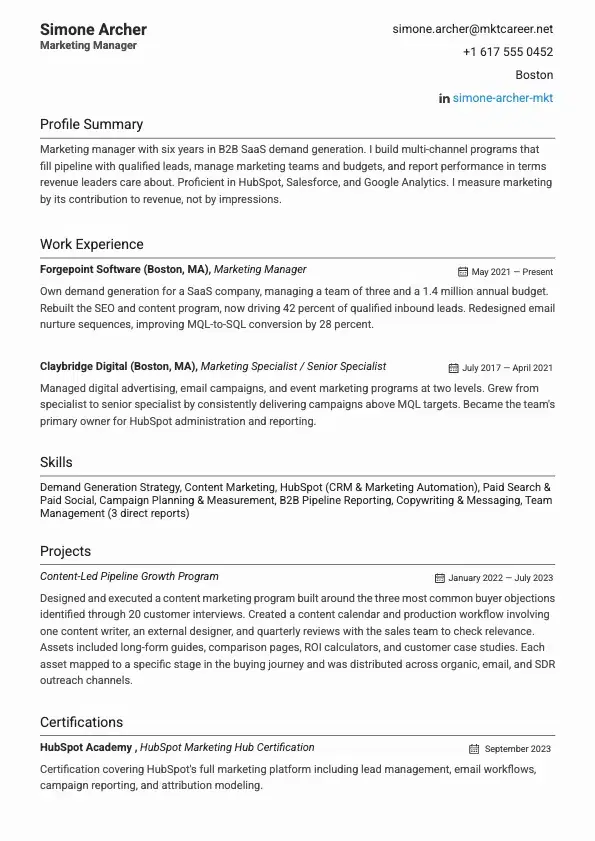
Resume Example
Marketing Manager Resume
Marketing manager resume featuring campaign management, brand strategy, paid media, and team leadership.
Use This SampleCreate from Scratch- ATS-Friendly Format
- Expert-Crafted Content
- Free to Customize
Key Skills Featured in This Example
These competencies appear throughout the resume to pass ATS filters and impress hiring managers.
Why This Resume Works
It spans the full demand engine, not one channel
The sample covers campaign management, paid media across Google Ads and Meta Ads, email marketing, brand strategy, and analytics, which is exactly the scope of a real marketing manager role. Hiring teams are wary of channel specialists relabeled as managers, so demonstrating orchestration across paid, owned, and brand work signals genuine breadth. It also matches more posting keywords, since manager-level requisitions almost always list several channels plus strategy and reporting requirements.
Named tools make the experience verifiable and searchable
HubSpot, Google Ads, and Meta Ads are named outright rather than hidden behind phrases like marketing automation and paid social. Recruiters run candidate searches on tool names, and ATS keyword matching is literal, so the named stack keeps the resume in results where a vaguer version disappears. For the human reader, specific tools also imply specific competencies: HubSpot implies lifecycle and lead-nurture fluency, and the ad platforms imply hands-on budget management rather than agency-watching.
Team leadership sits next to hands-on execution
By pairing team leadership with campaign management and channel skills, the sample answers the question every marketing manager posting embeds: can this person both run the plan and do the work? Companies at this level want a player-coach who can brief designers, manage a coordinator, and still audit ad spend or fix an email workflow personally. Showing both dimensions widens the range of org structures the candidate fits, from first marketing manager at a startup to team lead inside a larger department.
What Hiring Teams Look For in a Marketing Manager Resume
Revenue and pipeline impact with attribution
Example: Generated $2.1M in marketing-sourced pipeline in one year, as an example, through integrated Google Ads, Meta Ads, and email nurture campaigns, tracked via HubSpot attribution reporting.
CMOs defend marketing budgets with sourced-revenue numbers, so candidates who report their own results in those terms are immediately credible. Naming the attribution method also preempts the standard skepticism about whether marketing is claiming sales results.
Budget ownership and efficiency
Example: Managed an example annual paid media budget of $600K across Google and Meta, reducing blended CAC roughly 25 percent through landing page testing, audience refinement, and budget reallocation toward high-converting segments.
Budget size calibrates seniority instantly, and an efficiency result proves the money was managed rather than merely spent. In a market focused on efficient growth, cost-per-acquisition improvements often land harder than raw volume growth.
People and agency leadership
Example: Led a team of three marketers and two agency partners, setting quarterly OKRs and campaign briefs, and promoted one direct report to senior specialist.
Manager titles without management evidence are common, so hiring teams look for team size, goal-setting mechanics, and development outcomes. A promotion or retention detail signals real leadership rather than dotted-line coordination.
Testing and analytics discipline
Example: Ran a continuous A/B testing program across email subject lines, ad creative, and landing pages, lifting email-attributed revenue about 30 percent year over year, as an example, with results reported monthly in GA4 and HubSpot dashboards.
Experimentation cadence separates data-driven operators from campaign schedulers. Describing the loop, hypothesis, test, measurement, and reallocation, tells hiring managers your decisions survive contact with attribution data.
How to Write a Marketing Manager Resume, Step by Step
Choose a metric-forward format and clean header
Use a reverse-chronological, single-column layout that ATS parsers read cleanly, with your name, city, phone, email, and LinkedIn URL in the header. Marketing hiring managers will look at your LinkedIn regardless, so make sure it matches your resume and add a portfolio or campaign case-study link if you have one. Skip headshots, skill-rating bars, and dense graphics; in a marketing screen, over-designed resumes read as compensating for weak numbers.
Pro tip: Give your title line a scope marker, for example Marketing Manager | B2B SaaS | Demand Generation and Lifecycle. Recruiters filter hard by industry and motion, and this line does that work instantly.
Open with a summary that quantifies scope and impact
In three lines, state your years of experience, industry and company stage, the size of budget and team you have run, and one headline result. For example: Marketing manager with 7 years in B2B SaaS, leading a team of 4 and a seven-figure annual budget; drove a 45 percent increase in marketing-sourced pipeline in the last fiscal year. This front-loads the calibration data recruiters need, seniority, scope, and proof, into the first five seconds of reading.
Pro tip: Rewrite the summary for each application to mirror the posting’s emphasis, whether demand generation, brand, product marketing, or lifecycle. The rest of the resume can stay stable; the summary must match the job.
Write experience bullets as metric stories, not channel lists
For each role, lead with the outcome bullet: pipeline, revenue, CAC, conversion rate, or retention movement, with the timeframe. Follow with 3 to 5 bullets covering campaign strategy, paid media management with spend levels, email and lifecycle programs, brand or content initiatives, and team leadership. Every bullet should follow action, mechanism, result: what you did, how, and what changed. Where a number is confidential, use percentages or ranges rather than dropping quantification entirely.
Pro tip: Include at least one bullet about cross-functional work with sales or product, such as lead-scoring alignment or launch support. Marketing managers are hired partly on their ability to keep the sales relationship functional.
Build a skills section around stack and strategy keywords
List the tools and disciplines postings actually name: Google Ads, Meta Ads, HubSpot or your CRM and automation platform, GA4, email marketing, SEO and content strategy if applicable, campaign management, and budget management. Group them if it helps readability, for example platforms versus disciplines. Match the exact spellings in the target posting, since paid social will not always keyword-match a posting that says Meta Ads. Cap the list around a dozen entries you could discuss in depth.
Pro tip: Add measurement vocabulary, such as attribution modeling, CAC and LTV analysis, and A/B testing, as skills. Analytics terms are among the most-filtered keywords in current marketing manager searches.
Finish with education, certifications, and proof of currency
List your degree briefly, then current, verifiable certifications: Google Ads and Google Analytics certifications, HubSpot Marketing Software or equivalent, and Meta Blueprint if you run paid social. These expire and screeners know it, so current ones signal you still operate hands-on. If you have public work, a rebrand, a campaign with published results, or conference talks, link it here or in your header; in marketing, demonstrable output beats one more bullet.
Pro tip: Skip expired or trivial certifications. One current Google Ads certification outweighs five stale badges, and a padded certification list undermines the senior positioning of the rest of the resume.
How Much Does a Marketing Manager Make?
Low
$81,900
per year (US)
Median
$161,030
per year (US)
High
$239,200
per year (US)
The unusually wide range reflects how much company size, industry, and scope drive marketing pay: managers at large tech and pharmaceutical firms or in major metros earn multiples of what small-company generalists make. Demand generation and growth-focused roles with clear revenue attribution, plus bonus and equity at larger companies, account for much of the top end.
Salary data based on U.S. Bureau of Labor Statistics, May 2024 Occupational Employment and Wage Statistics for Marketing Managers; low and high reflect the 10th and 90th percentile annual wages.
Key Takeaways
A marketing manager resume wins when every section answers the attribution question: state your scope, budget, team, and industry up front, then prove movement in the metrics executives actually track, pipeline, CAC, conversion, and revenue, with the mechanism and the measurement stack named. Show breadth across paid, email, brand, and analytics while making leadership concrete with team sizes and outcomes. Name your tools for the ATS, mirror each posting’s emphasis in your summary, and cut anything, buzzwords, expired badges, unquantified activity, that a skeptical marketer would skim past, because the person screening you evaluates persuasion for a living.
Marketing Manager Resume FAQs
What metrics should a marketing manager put on a resume?
Prioritize business outcomes: marketing-sourced pipeline and revenue, CAC or cost per lead, conversion rates, ROAS, email revenue, and retention or LTV movement where relevant. Pair each with a timeframe and, ideally, the measurement source, such as HubSpot attribution or GA4. Vanity metrics like impressions and follower counts only belong on your resume when tied to a downstream result.
How do I show results if my company keeps revenue confidential?
Use percentages, ratios, and ranges instead of absolute figures: grew qualified pipeline 40 percent year over year, or cut CAC by a quarter on flat spend. Percentage improvements are fully compliant with confidentiality obligations and are what hiring managers calibrate on anyway. Budget figures can be expressed as ranges, such as managed a mid-six-figure annual paid budget.
Should a marketing manager resume include Google Ads and HubSpot certifications?
Yes, if they are current. Google Ads, Google Analytics, HubSpot, and Meta Blueprint certifications are free or cheap, expire regularly, and therefore act as proof you still work hands-on in the platforms. They matter most for candidates moving up from specialist roles or switching industries; for very senior candidates, results outweigh badges, but current certifications never hurt.
How long should a marketing manager resume be?
One page up to roughly 8 to 10 years of experience, two pages beyond that if the content is dense with results. Recruiters spend well under a minute on the first pass, so the top third of page one, your summary and most recent role, must carry your best numbers. Cut early-career roles to one or two lines each rather than adding a page.
Do I need a portfolio as a marketing manager?
It is not mandatory the way it is for designers, but a short case-study link, one or two campaigns with objective, approach, and measured results, differentiates you sharply. It also solves the confidentiality problem by letting you narrate anonymized outcomes. A well-maintained LinkedIn with published results or launch announcements can serve the same function.
How do I tailor my resume for demand generation versus brand roles?
Keep your experience bullets stable but rewrite the summary and reorder skills to match the posting’s center of gravity: pipeline, CAC, and lifecycle language for demand gen roles; positioning, campaign creative, and awareness-to-revenue linkage for brand roles. Most manager postings blend both, so read which metrics the posting mentions first and mirror that hierarchy. Exact keyword matching also matters for the ATS pass.
Should I list AI tools on a marketing manager resume?
Yes, but framed as leverage, not as the skill itself: for example, used AI-assisted workflows to cut campaign production time while maintaining brand standards. In 2026, hiring managers assume tool familiarity; what differentiates you is judgment about where AI fits in the workflow and how you maintained quality and measurement discipline. Avoid listing a dozen AI apps, which reads as trend-chasing.
How do I move from marketing specialist to marketing manager on my resume?
Surface every leadership-shaped fact you have: interns or contractors you directed, agency relationships you managed, budgets you controlled, and cross-functional projects you led. Write your specialist results at the level a manager would report them, business outcomes rather than task completion. A summary line stating you are operating at manager scope, for example owning a channel budget and mentoring two coordinators, reframes the same history upward honestly.
Is team leadership required to get a marketing manager job?
Not always; many marketing manager roles, especially first marketing hires at startups, are individual-contributor positions with program ownership rather than direct reports. Postings usually signal which type they are. If you lack direct reports, emphasize budget ownership, agency and freelancer management, and cross-functional leadership, which demonstrate the same coordination skills.
What keywords do ATS systems look for in marketing manager resumes?
The most common are channel and tool terms, campaign management, Google Ads, Meta Ads, SEO, email marketing, HubSpot or Salesforce, GA4, plus strategy and measurement terms like brand strategy, demand generation, A/B testing, and budget management. Pull the exact phrases from each posting, since matching is literal. Place them in both your skills section and your experience bullets so they appear in context, not just in a list.
Turn This Example Into Your Resume
Use this sample as your starting point. Customize it in minutes, export as a PDF, and apply with confidence.