Product Manager Resume
Product manager resume showcasing roadmap ownership, cross-functional leadership, and agile delivery.
Product manager hiring in 2026 is the most competitive it has been in a decade: tech-sector PM openings shrank while the number of experienced PMs grew, so a single posting can draw a thousand applicants and companies filter accordingly. Automated screening ranks resumes on keyword and outcome match — roadmap, OKRs, A/B testing, activation, retention — and the recruiters behind it have developed a fast heuristic for separating operators from passengers: does each bullet show a product outcome the candidate drove, or a process they attended? 'Managed the roadmap and ran sprint ceremonies' is a passenger sentence. 'Reprioritized the roadmap around activation, lifting week-one retention 18%' is an operator sentence.
The evaluation has also become more evidence-hungry because PM titles are notoriously inflated. Hiring managers triangulate: metrics in the bullets, scope indicators (team size, revenue touched, users served), and fluency signals like experiment volume or SQL self-sufficiency. Since AI tooling now drafts specs and user stories cheaply, screeners weight judgment — what you chose to build, what you killed, what you learned from a failed test — over artifact production. The example on this page is engineered for that reading, and the guide below shows how to write yours the same way.
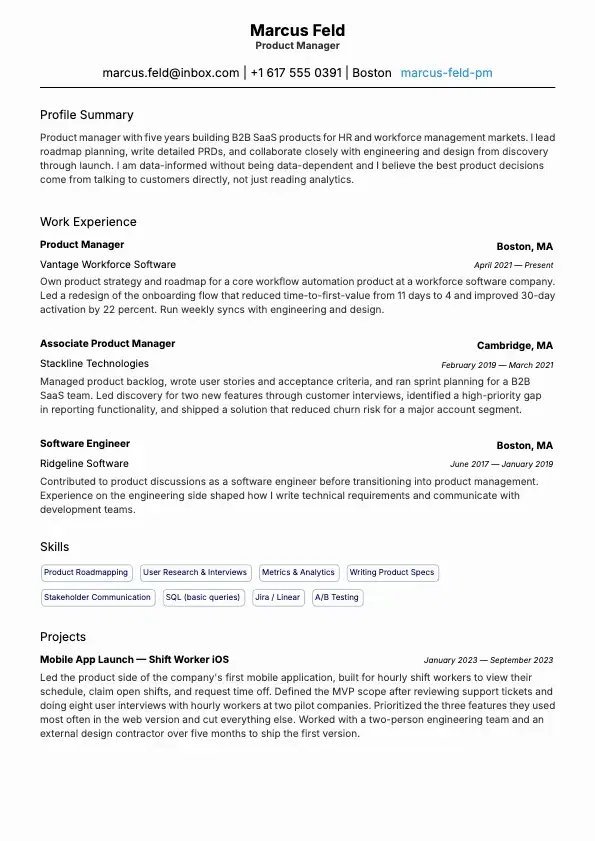
Resume Example
Product Manager Resume
Product manager resume showcasing roadmap ownership, cross-functional leadership, and agile delivery.
Use This SampleCreate from Scratch- ATS-Friendly Format
- Expert-Crafted Content
- Free to Customize
Key Skills Featured in This Example
These competencies appear throughout the resume to pass ATS filters and impress hiring managers.
Why This Resume Works
Outcomes lead, ceremonies follow
Every experience bullet in this example is anchored to a product metric — activation, retention, conversion, revenue — with agile mechanics (sprints, JIRA, user stories) appearing only as the how, never the what. That inversion is exactly what senior reviewers scan for, because running ceremonies is table stakes while moving metrics is the job. The resume still carries the process keywords ATS filters need (Agile, Scrum, JIRA, roadmapping), but always in service of a result.
Scope is stated, so the title is believable
PM titles range from backlog administrator to mini-GM, and screeners know it. This example disambiguates by quantifying scope in the first bullet of each role: the surface owned, the size of the cross-functional team, the user base or revenue affected. That lets a hiring manager instantly calibrate level — and a candidate who states scope plainly reads as more senior than one who inflates adjectives while hiding numbers.
Evidence-based decision-making is shown, not claimed
The skills list pairs discovery and delivery tools (Figma, user stories) with analytical ones (A/B testing, SQL, OKRs), and the bullets back them up: experiments shipped, data pulled personally, goals framed as key results. 'Data-driven' as an adjective is ignored by every screener; twelve experiments and a SQL-backed prioritization call are proof. This combination — builder empathy plus analytical self-sufficiency — is the current market's most-filtered-for PM profile.
What Hiring Teams Look For in a Product Manager Resume
A metric you moved, with the mechanism
Example: Redesigned onboarding around an aha-moment analysis, cutting time-to-first-value from 3 days to 20 minutes and lifting 30-day retention by 22%.
This is the core PM hiring signal: metric, mechanism, magnitude. It survives the interview drill-down ("how did you find the aha moment? what did you trade off?") that kills vague impact claims, and AI screeners rank measurable-outcome language above process language.
Prioritization with visible trade-offs
Example: Killed a half-built integrations feature after discovery interviews showed single-digit willingness to pay, reallocating two engineers to a checkout revamp that grew conversion 15%.
Anyone can add to a roadmap; deciding what not to build is the scarce skill. A kill decision with reasoning and a redeployment payoff signals judgment and stakeholder spine — the qualities hiring managers say are hardest to screen for.
Experimentation velocity and honest learning
Example: Ran 15+ A/B tests on the activation funnel in a year; the winning variants compounded to a 25% signup-to-paid improvement, and two failed tests redirected the quarterly roadmap.
Test volume signals a working discovery process rather than a one-off win. Mentioning failed tests is deliberate: it reads as intellectual honesty, and interviewers increasingly probe for what candidates learned from experiments that lost.
Cross-functional leadership at stated scale
Example: Led a 9-person engineering-design pod and aligned sales, support, and legal stakeholders to ship a compliance-sensitive payments feature on schedule across 3 markets.
PMs lead without authority, so screeners look for the size and diversity of the group you aligned and evidence it shipped. Naming the functions and the constraint (compliance, multi-market) makes the leadership claim concrete instead of decorative.
How to Write a Product Manager Resume, Step by Step
Format for a 30-second skim and a strict parser
Single column, standard headings, reverse-chronological, one page up to about 10 years of product experience. Header: name, city and state, email, phone, LinkedIn in plain text. PM applications routinely draw huge volume, which means both the ATS pass and the human pass are faster and less forgiving than average — no tables, no graphics, no clever section names that break parsing.
Pro tip: Make your title line in each role explicit about domain and level — 'Senior Product Manager, Payments' filters far better than 'Product Manager' alone.
Write a summary that states scope and one headline outcome
Three lines: years in product, domains (B2B SaaS, marketplace, fintech, consumer), the scope you have owned, and your single best metric story. Example: 'Product manager with 6 years in B2B SaaS; owned an activation surface serving 200K users and drove the roadmap shift that lifted net revenue retention from 98% to 112%.' Domain keywords are heavily filtered — say your industry explicitly.
Pro tip: Match seniority language to the posting: applying to a "Product Manager" role with a summary that says "product leader" triggers overqualification doubts, and the reverse reads as reaching.
Turn each role into 3-6 outcome bullets across the PM skill map
Cover the dimensions hiring managers assess: metric impact (activation, retention, revenue), discovery (research, experiments), prioritization (trade-offs, roadmap calls), execution (shipping with engineering and design), and stakeholder work. One bullet per dimension beats six shipping bullets. Attach a number to every bullet — percentage lift, users affected, revenue touched, time saved — using honest approximations where exact figures are confidential.
Pro tip: Write bullets as "outcome by mechanism" — lead with the result, then the how. Screeners skim only the first half of each line, so put the number in it.
Build a skills section that covers both process and evidence keywords
Group into Product Practice (roadmapping, OKRs, user stories, stakeholder management), Methods (Agile/Scrum, A/B testing, user research), and Tools (JIRA, Figma, SQL, analytics platforms). SQL deserves special mention if you have it — data self-sufficiency is a top differentiator in current PM screens. Keep the list honest; PM interviews probe every claimed skill through behavioral drill-downs.
Pro tip: List frameworks only if you actually use them; name-dropping RICE or Jobs-to-be-Done invites an interview question that exposes surface familiarity in about ninety seconds.
Close with education, certifications, and selective extras
Degree, institution, year — an MBA merits a line, not a paragraph. Certifications (CSPO, Pragmatic, Reforge) are weak signals for experienced PMs but useful keyword coverage for career changers coming from engineering, design, or analytics. If you transitioned into product, add a one-line bridge showing your prior craft as an asset: technical depth, design sense, or analytical rigor.
Pro tip: A side project or product teardown blog earns an extras line only if it demonstrates product thinking publicly — a link a hiring manager can skim in two minutes.
How Much Does a Product Manager Make?
Low
$119,202
per year (US)
Median
$150,990
per year (US)
High
$194,235
per year (US)
The range is driven by level, company stage, and industry: associate PMs and PMs at smaller companies sit below this band, while senior and group PMs at large tech firms exceed it — 90th-percentile reports run around $241,000, before equity, which at major tech companies often adds substantially to total compensation. Information technology and fintech pay at the top of the range.
Salary data based on Glassdoor U.S. Product Manager salary estimates (25th percentile, average, and 75th percentile base pay), 2025-2026.
Key Takeaways
A product manager resume wins by proving you moved metrics, made real trade-offs, and led teams you did not manage — with numbers and mechanisms, not adjectives. State your scope so your title is believable, cover the keyword surface (roadmapping, OKRs, A/B testing, Agile, JIRA, SQL) inside outcome-first bullets, and keep the format skimmable in 30 seconds. In a market where a thousand applicants chase one posting, the resumes that surface are the ones that read like a record of product judgment: what you chose, what you killed, what happened, and what you learned.
Product Manager Resume FAQs
How long should a product manager resume be?
One page for up to roughly 10 years of experience; two pages only for senior leaders with genuinely distinct chapters. PM postings draw enormous applicant volume, so screeners skim fast — a dense single page of metric-led bullets outperforms a comprehensive two-pager. Compress early or non-product roles to a line each.
What metrics should a product manager put on a resume?
The metrics your products were accountable for: activation, retention, conversion, engagement, revenue or net revenue retention, NPS if it drove decisions. Pair each with the mechanism ("lifted X by doing Y") rather than claiming the number alone. If exact figures are confidential, use percentage changes or honest approximations — screeners expect quantification and discount bullets without it.
How do I write a product manager resume with no PM title?
Mine your current role for product work you already did: features you specced, experiments you ran, prioritization calls you influenced, cross-functional projects you led. Write those as outcome bullets using PM vocabulary (roadmap, user stories, A/B testing) where accurate. A summary line framing your transition — "engineer moving into product after two years of de facto feature ownership" — helps screeners categorize you.
Do product manager certifications like CSPO help on a resume?
Marginally. For experienced PMs they add keyword coverage and little else; outcomes on real products carry nearly all the weight. For career changers, a CSPO or Reforge course signals commitment and vocabulary, but it must sit beside concrete evidence of product thinking — a side project, internal transfer work, or a teardown portfolio — to matter.
Should a product manager resume mention specific tools like JIRA and Figma?
Yes, briefly — JIRA, Figma, and an analytics stack (Amplitude, Mixpanel, or GA) are common ATS keywords, and SQL is worth featuring prominently if you have it. But keep tools to a compact line; hiring managers evaluate PMs on judgment and outcomes, and a tools-heavy resume reads junior. Never let a tool list crowd out a metric bullet.
How technical does a product manager resume need to be?
Enough to show self-sufficiency for your target segment: SQL and experiment literacy for most software PM roles, deeper technical fluency (APIs, architecture trade-offs) for platform or infrastructure PM roles. Show it through bullets — "pulled my own SQL for the prioritization model" — rather than listing programming languages you do not use. Do not oversell; technical drill-downs are standard in PM loops.
How is a product manager resume different from a project manager resume?
A product manager resume centers on what to build and why — product metrics, discovery, roadmap trade-offs. A project manager resume centers on delivery — schedule, budget, scope, and risk on defined initiatives. Recruiters filter these as different roles, so pick the vocabulary of the one you want; a hybrid resume that mixes both usually fails both filters.
How should I tailor my PM resume for each application?
Adjust three things per posting: mirror the exact title and seniority in your summary, swap your lead bullets so the most relevant domain and metric stories come first, and align keyword phrasing (OKRs vs. goals, experimentation vs. A/B testing) with the posting language. Fifteen minutes of tailoring measurably outperforms volume applying with a static resume in this market.
Should I include failed products or experiments on my PM resume?
Selectively, yes — one bullet showing a kill decision or a failed test that redirected strategy signals judgment and honesty, which interviewers now probe for explicitly. Frame it as decision plus consequence: what evidence prompted the call and what the freed capacity produced. Avoid framing anything as failure without the redirect; the payoff half is what makes it a strength.
Can I use AI tools to write my product manager resume?
As an editor, absolutely — for structure, concision, and keyword coverage. But generic AI-written PM resumes have become recognizable to recruiters and uniformly lack the specific metrics, trade-offs, and scope details that drive PM screening. Supply your real numbers and decisions first; a tool like Resunote can then handle formatting and ATS alignment without flattening your story.
Turn This Example Into Your Resume
Use this sample as your starting point. Customize it in minutes, export as a PDF, and apply with confidence.