Project Manager Resume
PMP-aligned project manager resume with cross-functional delivery, risk management, and stakeholder comms.
Project manager resumes are screened against a checklist that has hardened in the 2026 market: methodology keywords (PMP, Agile, Scrum), tool names (JIRA, MS Project), and — the part most candidates miss — delivery numbers. Because project management spans every industry, ATS filters lean heavily on certifications and exact-phrase matches to cut applicant volume, and PMP remains the single strongest filter term for mid-level and senior roles. Past the software layer, recruiters apply a simple credibility test: does this person state what they delivered, at what budget, with what team, against what deadline? A resume full of 'coordinated cross-functional teams' with no scope numbers fails that test regardless of experience.
Two shifts define the current evaluation. First, hybrid delivery is the norm: employers want PMs fluent in both predictive (waterfall, MS Project, stage gates) and agile (Scrum, JIRA, sprints) modes, and resumes that show only one read as narrow. Second, as AI tools absorb status reporting and schedule mechanics, hiring managers weight the judgment layer — risk anticipation, stakeholder alignment, recovery of troubled projects — more than administrative competence. The example on this page is built around delivery evidence and that judgment layer, and the sections below show exactly how to structure yours.
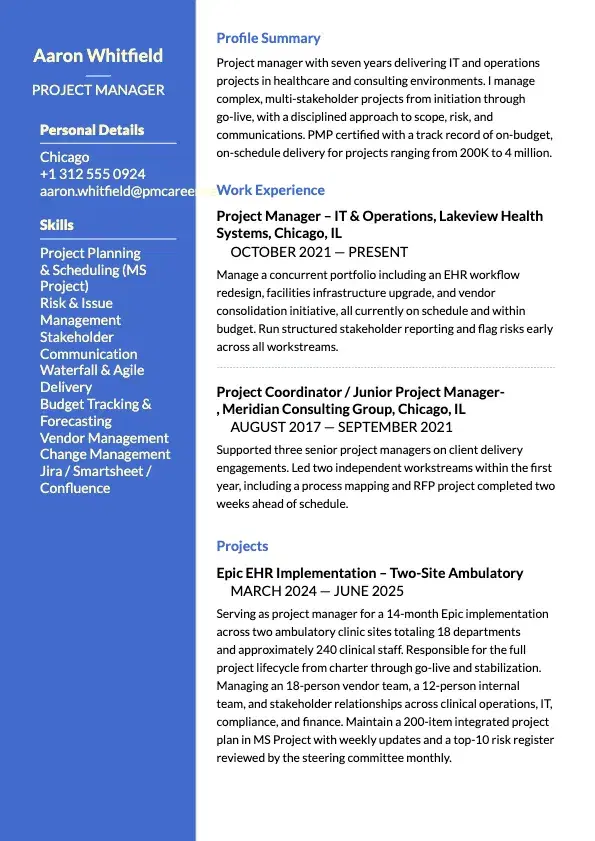
Resume Example
Project Manager Resume
PMP-aligned project manager resume with cross-functional delivery, risk management, and stakeholder comms.
Use This SampleCreate from Scratch- ATS-Friendly Format
- Expert-Crafted Content
- Free to Customize
Key Skills Featured in This Example
These competencies appear throughout the resume to pass ATS filters and impress hiring managers.
Why This Resume Works
Certification and methodology keywords are placed where filters look
This example puts PMP directly beside the name at the top and repeats Agile/Scrum, MS Project, and JIRA in the skills section — the exact terms ATS filters and recruiter searches run on. Placement matters: a certification buried at the bottom of page two can miss a recruiter's ten-second scan even when it passes the software filter. The resume also shows both predictive and agile delivery in its bullets, which matches the hybrid reality most employers now hire for.
Every project has a size: budget, team, timeline
The fastest way for a screener to level a project manager is scope, and this example quantifies it in nearly every bullet — budget managed, headcount coordinated, vendors handled, duration against plan. 'Managed projects' is unverifiable; 'delivered a $2M ERP migration with a 14-person cross-functional team, two weeks early' is checkable, levelable, and interview-ready. Scope numbers do more for a PM resume than any adjective.
Risk and stakeholder work is shown as prevention, not process
Risk management appears in this example as outcomes — issues caught early, escalations resolved, slippage avoided — rather than as ceremony descriptions like "maintained the risk register." The same applies to stakeholder communication: the bullets show alignment achieved across competing interests, not meetings held. Hiring managers read this as the difference between a PM who administers a process and one who protects a delivery, and they hire the second.
What Hiring Teams Look For in a Project Manager Resume
On-time, on-budget delivery at stated scale
Example: Delivered a $3.5M warehouse-management system implementation across 4 sites on schedule and 5% under budget, coordinating a 20-person team and 3 vendors.
This is the headline PM signal: it levels you instantly (budget and team size), proves the core competency (schedule and cost control), and gives the interviewer a concrete case to probe. Even smaller honest numbers work — the pattern of scope plus result is what screeners scan for.
Risk caught before it became a crisis
Example: Flagged a vendor dependency risk in week 2 of planning and negotiated a parallel workstream, avoiding an estimated 6-week slip when the vendor did deliver late.
Anticipating risk is the judgment skill certifications cannot certify. A bullet showing early detection plus a mitigation that paid off tells a hiring manager you run projects proactively — the trait most cited when explaining why a PM hire succeeded or failed.
A troubled project recovered
Example: Took over a stalled CRM rollout 4 months behind schedule, rebaselined scope with executive sponsors, and delivered the revised plan on time with stakeholder sign-off.
Turnaround stories are disproportionately persuasive because they compress every PM skill — assessment, stakeholder negotiation, replanning, execution — into one narrative. Screeners flag these bullets for interview discussion, which means the resume has done its job.
Fluency across predictive and agile delivery
Example: Ran the infrastructure workstream on a stage-gate plan in MS Project while managing the software workstream in two-week Scrum sprints in JIRA, keeping both aligned to a single milestone map.
Most real portfolios are hybrid, and employers increasingly filter for PMs who can operate both modes without dogma. Demonstrating the two side by side — with the tools named — covers both keyword families and signals adaptability in one line.
How to Write a Project Manager Resume, Step by Step
Lead with credentials in a clean, parseable header
Put certifications directly after your name — 'Jane Rivera, PMP' — then city and state, phone, email, and LinkedIn in plain text. Use a single-column layout with standard headings and reverse-chronological order. Project management postings draw high volume across industries, so both the ATS and the recruiter pass are quick; a Gantt-chart graphic or two-column design that breaks parsing costs more here than in most professions.
Pro tip: Spell out and abbreviate on first use — 'Project Management Professional (PMP)' — so you match searches for either form.
Write a summary that states scale, industries, and methodology range
Three lines: years of experience, industries you have delivered in, the scale you operate at, and your methodology fluency. Example: 'PMP-certified project manager with 8 years delivering IT and operations projects up to $5M; led teams of 5-20 across agile and waterfall environments with a record of on-time, on-budget completion.' Industry keywords matter because many employers filter for domain familiarity as hard as credentials.
Pro tip: If your delivery record is genuinely strong, put a number on it in the summary — a specific claim like 12 projects delivered with 90%+ on-time performance is the line recruiters remember.
Structure experience bullets as scope, action, outcome
For each role, select 3-6 projects or achievements and give every bullet three parts: the scope (budget, team size, duration, sites), what you did (planned, recovered, negotiated, rebaselined), and the outcome against plan (on time, under budget, slippage avoided, adoption achieved). Cover the full skill map across your bullets: schedule and budget control, risk management, stakeholder communication, and at least one recovery or escalation story.
Pro tip: Express outcomes relative to the plan — "two weeks early," "5% under budget," "zero scope-driven overruns" — because plan-relative numbers are the currency of PM credibility.
Build a skills section around methods, tools, and governance
Group into Methodologies (Agile/Scrum, waterfall, hybrid delivery), Tools (MS Project, JIRA, plus any portfolio tools like Smartsheet or Asana you use), and Core Practice (risk management, budget management, stakeholder communication, resource planning). Match the posting vocabulary exactly — a job asking for "Scrum" may not match a resume that only says "agile ceremonies." List only tools you can operate live.
Pro tip: Include budget management explicitly as a skill and back it with the largest budget figure from your bullets — financial accountability is a distinct filter for senior PM roles.
Close with education, certifications, and professional activity
List your degree, then a Certifications section with names, issuers, and years: PMP (PMI), CSM or PSM if you hold them, PRINCE2 for internationally-oriented roles, and any agile-at-scale credentials. Current certifications matter — an expired PMP is worse than none, so show renewal status is current. PMI chapter involvement or mentoring earns one line if genuine; it signals professional community without padding.
Pro tip: If you are pursuing PMP, write "PMP candidate — exam scheduled [month, year]" only when the date is real; recruiters treat vague "in progress" claims as filler.
How Much Does a Project Manager Make?
Low
$59,830
per year (US)
Median
$100,750
per year (US)
High
$165,790
per year (US)
The spread reflects industry, certification, and scope: coordinators and PMs in lower-paying sectors sit near the bottom, while PMP-certified managers running large programs in IT, construction, and finance reach the top decile. PMI's own surveys consistently find PMP holders out-earning uncertified peers by a wide margin, and program or portfolio responsibility pushes pay further up.
Salary data based on U.S. Bureau of Labor Statistics, May 2024 Occupational Employment and Wage Statistics for Project Management Specialists (10th percentile, median, and 90th percentile annual wages).
Key Takeaways
A project manager resume earns interviews by making delivery verifiable: certifications where filters look, scope numbers on every project (budget, team, timeline), and outcomes stated against plan. Show both predictive and agile fluency with the tools named, spend at least one bullet each on risk prevented and a delivery recovered, and keep the format single-column and parseable. In a profession where every candidate claims to deliver on time and on budget, the resumes that advance are the ones that put numbers behind the claim — and give the interviewer a specific project story worth probing.
Project Manager Resume FAQs
How long should a project manager resume be?
One page up to roughly 10 years of experience; two pages are acceptable for senior PMs with substantial program portfolios. Screeners skim for certifications and scope numbers first, so density of evidence matters more than completeness. Summarize projects older than 10 years in a single line or drop them.
Is PMP certification worth putting on a resume?
Yes — PMP is the strongest single keyword filter in project management hiring and is required or preferred in a large share of mid-to-senior postings. Put it beside your name in the header and again in a certifications section with the year. If you hold it, surveys consistently show it also correlates with meaningfully higher pay.
How do I write a project manager resume with no formal PM title?
Extract the project work from your current role: initiatives you planned, budgets you tracked, teams you coordinated, deadlines you owned. Write them as scope-action-outcome bullets using PM vocabulary — schedule, risk, stakeholders — where accurate. A CAPM or Google Project Management certificate adds keyword legitimacy while your bullets prove you have already done the job informally.
What numbers should a project manager put on a resume?
Budget managed, team size, project duration against plan, number of concurrent projects or workstreams, vendors coordinated, and outcome deltas (weeks saved, percent under budget, slippage avoided). Plan-relative numbers are the most persuasive. If exact budgets are confidential, use ranges or approximations you can defend in an interview.
Agile or waterfall — which should my resume emphasize?
Both, honestly weighted toward your target roles. Most employers now run hybrid delivery, so a resume showing Scrum and JIRA alongside MS Project and stage-gate planning matches more filters and reads as adaptable. If a posting is explicitly agile, lead with sprint-based bullets; the reverse for construction or infrastructure roles.
What tools should a project manager list on a resume?
The ones postings in your segment name: MS Project and JIRA are the most commonly filtered, with Smartsheet, Asana, Monday, and Confluence appearing often. Excel remains assumed but worth listing for budget-tracking-heavy roles. List only tools you can use in a live exercise, and tie the top two into experience bullets so they read as practiced rather than listed.
How is a project manager resume different from a program manager resume?
A project manager resume centers on delivering defined initiatives — scope, schedule, budget, risk on individual projects. A program manager resume shows coordination of multiple related projects toward a strategic outcome, with emphasis on interdependencies, benefits realization, and executive stakeholders. If you are stepping up, include at least one bullet showing multi-project or portfolio-level coordination.
Should I list every project I have managed?
No — select the 3-6 most significant per role by scope, complexity, or outcome, and let a summary line carry the rest ("delivered 15+ projects totaling $12M"). A resume that itemizes every project reads as a task log and buries your strongest evidence. Choose projects that collectively cover schedule, budget, risk, and stakeholder skills.
How do I explain a failed or cancelled project on my resume?
On the resume, frame what you controlled: scope rebaselined, losses contained, orderly closure delivered, lessons applied to later successes. A cancellation driven by business strategy is not a PM failure and needs no defense. Keep the fuller narrative for interviews — but one honest recovery-or-containment bullet often reads as more senior than an unbroken string of green-status claims.
Do project managers need technical skills on their resume?
For IT and software project roles, yes at the fluency level: enough SDLC, cloud, or systems vocabulary to run credible conversations with engineers, shown through the projects you delivered rather than a programming language list. For construction, healthcare, or operations PM roles, domain knowledge plays the same part. Deep technical execution skills are a bonus, not the filter.
Turn This Example Into Your Resume
Use this sample as your starting point. Customize it in minutes, export as a PDF, and apply with confidence.