Registered Nurse Resume
RN resume covering medical-surgical care, patient assessment, medication administration, and charting.
Registered nurse resumes are screened differently from almost any other profession because the first gate is verification, not persuasion. Hospital applicant tracking systems, most commonly Workday, Oracle Cerner-integrated HR suites, and iCIMS, are configured to flag license type, license state, compact status, and certifications like BLS and ACLS before a recruiter ever reads a bullet point. In 2026, with many health systems using automated credential-matching against Nursys, an RN resume that buries or omits license details gets stalled in screening even when the experience is strong. Nurse recruiters also move fast: large systems fill high-turnover med-surg and telemetry positions in days, and the average recruiter pass on a nursing resume is well under a minute.
What has changed recently is the premium on specificity. Staffing ratios, unit type, patient population, EHR platform, and charting proficiency are now standard screening criteria, because a nurse who has run a 1:5 med-surg assignment on Epic is a fundamentally different hire than one who has not, even if both resumes say patient care. The strongest RN resumes in the current market read like a clinical profile: unit, bed count, ratio, acuity, systems, and certifications, all stated plainly, followed by outcome-oriented bullets on safety, throughput, and patient education. Generic soft-skill language, by contrast, is actively discounted by nurse managers who review the final shortlist.
Resume Example
Registered Nurse Resume
RN resume covering medical-surgical care, patient assessment, medication administration, and charting.
Use This SampleCreate from Scratch- ATS-Friendly Format
- Expert-Crafted Content
- Free to Customize
Key Skills Featured in This Example
These competencies appear throughout the resume to pass ATS filters and impress hiring managers.
Why This Resume Works
License and certifications are impossible to miss
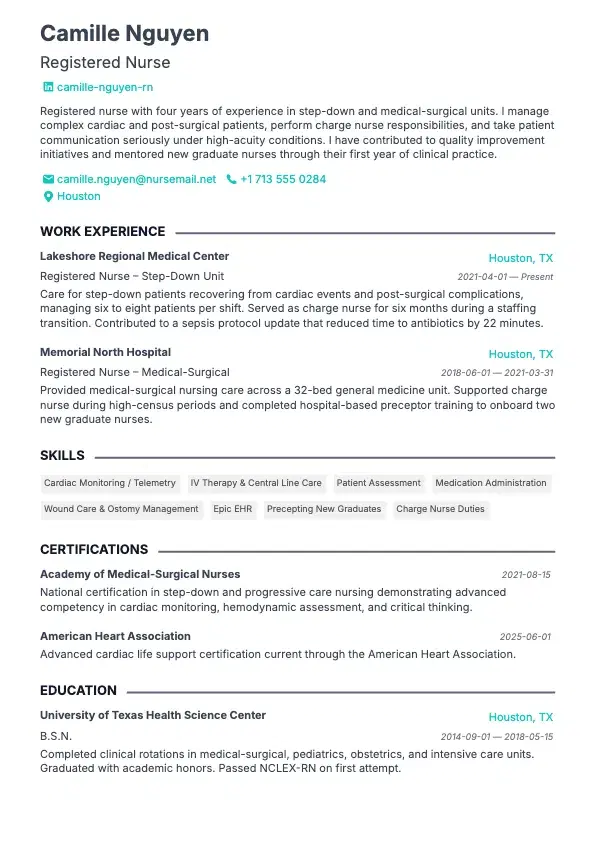
This sample places the RN license and the ACLS and BLS certifications where screeners look first, near the top of the document rather than buried under education. Nurse recruiters verify credentials before evaluating anything else, so the resume answers the disqualifying questions immediately: active license, current certifications, no gaps to investigate. Listing both ACLS and BLS also signals readiness for higher-acuity assignments, which widens the range of units the candidate can be routed to.
Clinical bullets are built around unit-level specifics
The experience section describes medical-surgical care in operational terms: patient assessment on defined caseloads, medication administration including IV therapy, wound care, and structured charting in the EHR. That maps one-to-one to how med-surg job descriptions are written, which is exactly what keyword-based ATS scoring rewards. It also lets a nurse manager reconstruct the candidate’s actual shift: what acuity they handled, what they documented, and what they can be trusted with on day one.
Keyword coverage matches how nursing jobs are actually posted
The skills list mirrors the vocabulary of real postings: patient assessment, IV therapy, medication administration, EHR and EMR documentation, patient education, and wound care. These are the exact phrases recruiters type into candidate searches and the exact requirements ATS filters check. Because the same terms also appear in context inside the experience bullets, the resume passes both automated matching and the human skepticism test, since every claimed skill is backed by where and how it was used.
What Hiring Teams Look For in a Registered Nurse Resume
Complete license and credential block
Example: Registered Nurse, State of Texas, License #123456, active through 2027, multistate privileges under the Nurse Licensure Compact; ACLS and BLS certified through the American Heart Association.
Credential verification is the first screening step for every nursing hire. Stating license number, state, expiration, and compact status up front lets recruiters confirm eligibility in one glance instead of chasing you for details, which is often the difference between same-day advancement and sitting in a pending queue.
Patient load and unit context in every role
Example: Managed care for 5 to 6 medical-surgical patients per shift on a 32-bed unit, completing head-to-toe assessments and prioritizing interventions across post-operative and chronic-condition populations.
Ratios and unit type tell a nurse manager exactly what acuity and workload you have proven you can handle. A resume without them forces the reviewer to guess, and guessing usually loses to the candidate who spelled it out.
Safety and quality outcomes, not just duties
Example: Maintained zero medication errors across an example span of 2,000+ administrations by following barcode scanning and independent double-check protocols, and contributed to a unit fall-reduction initiative.
Hospitals are graded and reimbursed on safety metrics like falls, medication errors, pressure injuries, and readmissions. Bullets tied to those metrics show you think in the same terms as the quality scorecard your future manager is accountable for.
Named EHR proficiency
Example: Documented assessments, medication administration records, and care plans in Epic, and trained two new graduate nurses on charting workflows during unit onboarding.
EHR retraining is a real cost and a real delay. Naming your platform, whether Epic, Oracle Health, or Meditech, tells the hiring team how fast you can chart independently, and many recruiters filter candidate searches by EHR name.
How to Write a Registered Nurse Resume, Step by Step
Set up the header with your credentials, not just your name
Format your name line as it appears on your license, followed by RN and your highest degree, for example Maria Alvarez, BSN, RN. Directly below, add a licenses and certifications line: license state and number, compact status if you hold a multistate license, and ACLS, BLS, or specialty certifications with expiration years. Keep the layout single-column with standard section headings so hospital ATS parsers read it cleanly, and skip photos, graphics, and tables entirely.
Pro tip: If you hold a compact license, say so explicitly. Multistate privileges make you eligible for more requisitions, and recruiters search for the word compact.
Write a summary that states your clinical identity in two lines
Lead with years of experience, specialty, and setting: for example, medical-surgical RN with 4 years of acute-care experience in a 300-bed community hospital. Then add one differentiator, such as charge nurse experience, preceptor duties, or a certification like MEDSURG-BC. Avoid adjectives like compassionate and dedicated standing alone; every nurse claims them, so they carry no screening weight. Tailor the specialty wording to the unit you are applying to.
Pro tip: Mirror the unit name from the posting. If the requisition says Telemetry/Stepdown, your summary should say telemetry or stepdown, not just med-surg.
Build experience bullets around assessment, intervention, and outcome
For each role, state the unit, bed count, and typical ratio in the first line, then write 4 to 6 bullets covering the clinical core: patient assessment, medication administration and IV therapy, wound care, care coordination, patient and family education, and EHR charting. Convert duties into results where you can: discharge teaching that reduced call-backs, protocol adherence that kept your error rate at zero, or precepting that got new hires to independent practice. Use past tense for previous roles and present tense for your current one.
Pro tip: One bullet per role should mention interdisciplinary work, such as rounding with hospitalists or coordinating with case management, because team communication is a scored competency in most nursing interviews.
Load the skills section with searchable clinical terms
List hard clinical skills that recruiters actually query: patient assessment, IV therapy and IV insertion, medication administration, wound care, telemetry monitoring if applicable, patient education, and your EHR by name. Match the exact phrasing in the job posting, since ATS matching is often literal, and EMR will not always match a posting that says EHR. Leave soft skills out of this section; demonstrate them in your bullets instead.
Pro tip: Keep the list to 8 to 12 items. A 25-skill wall reads as padding, and it dilutes the terms the ATS should weight most heavily.
Finish with education, certifications, and clinical extras in verifiable form
List your nursing degree with school and graduation year, then a dedicated certifications section with issuing body and expiration, for example ACLS, American Heart Association, expires 2027. New graduates should add clinical rotations with unit types and hours; experienced nurses can drop rotations and instead list committee work, preceptor roles, or unit-based council membership. If you are pursuing a certification such as CMSRN, list it as in progress with the expected date.
Pro tip: Never round certification expirations or leave them off. Recruiters verify against primary sources, and any mismatch triggers a manual review that slows your application.
How Much Does a Registered Nurse Make?
Low
$66,030
per year (US)
Median
$93,600
per year (US)
High
$135,320
per year (US)
RN pay varies widely with specialty, setting, and geography: ICU, OR, and emergency roles typically pay above med-surg, and states like California push experienced RNs well past the national high. Night and weekend shift differentials, overtime, and certifications such as CCRN or MEDSURG-BC can add meaningfully to base pay.
Salary data based on U.S. Bureau of Labor Statistics, May 2024 Occupational Employment and Wage Statistics for Registered Nurses; low and high reflect the 10th and 90th percentile annual wages.
Key Takeaways
A registered nurse resume succeeds when it verifies before it persuades: license, compact status, and current certifications visible in the first few seconds, followed by experience bullets that name the unit, the ratio, the patient population, and the EHR. Quantify what hospitals measure, such as safety events, education outcomes, and precepting, and mirror the exact clinical vocabulary of the posting so both the ATS and the nurse manager see an immediate match. Keep the format plain and parseable, keep every credential current and accurate, and tailor the specialty language to each unit you apply to rather than sending one generic version everywhere.
Registered Nurse Resume FAQs
Do I put my RN license number on my resume?
Yes. List your license state, number, and expiration in your header or a dedicated licenses section, and note compact status if you hold a multistate license. Recruiters verify every nursing license through Nursys, and providing the number up front removes a step that otherwise delays your application. The only common exception is public job boards, where some nurses list state and status only and provide the number in the application itself.
Should I write RN or BSN first after my name?
Standard credential order puts the permanent degree first, then licensure, then certifications: Jane Smith, BSN, RN, CMSRN. This is the convention recommended by the American Nurses Credentialing Center, and hiring teams read it as a sign you know professional norms. If you hold an MSN, it replaces the BSN in that sequence.
How long should a nurse resume be?
One page for new graduates and nurses with fewer than roughly 8 to 10 years of experience; two pages are acceptable for long clinical careers, travel nurses with many contracts, or nurses with leadership and committee work. Recruiters care more about scannable structure than page count, so never compress font size or margins to force one page.
How do new grad nurses write a resume with no experience?
Lead with your license and certifications, then treat clinical rotations as experience: list the facility, unit type, and hours, and write bullets about assessments, skills performed, and patient populations. Include your preceptorship or capstone unit prominently, since managers weight it as your closest analog to real practice. Externships, CNA or tech work, and volunteer clinical roles all belong on the resume too.
Should I list every certification, like BLS, or is that assumed?
List them all, including BLS. ATS filters frequently include BLS and ACLS as required keywords, and an assumed-but-absent certification can score your resume below threshold. Include the issuing body and expiration year for each so the recruiter can verify without contacting you.
How do I show patient ratios and unit size on my resume?
Put them in the first line under each job title, for example: 36-bed medical-surgical unit, typical ratio 1:5, post-surgical and chronic-care population. This gives hiring managers an instant read on the acuity and workload you have handled. If your ratio varied, state the typical range rather than omitting it.
Do hospital ATS systems really reject nursing resumes?
They rarely auto-reject, but they rank and filter. Recruiters search and sort candidates by keywords like license state, ACLS, Epic, and unit type, so a resume missing those terms is effectively invisible even though it was never formally rejected. Plain formatting and exact-match keywords from the posting keep you in the visible pool.
Should I include my EHR system, like Epic, on my resume?
Yes, by name, in both your skills section and at least one experience bullet. EHR proficiency shortens onboarding, and many recruiters filter searches by Epic, Oracle Health, or Meditech specifically. If you have used more than one system, list each, since it signals you adapt to new documentation workflows quickly.
How do I handle employment gaps on a nursing resume?
Address them briefly and factually, either with a one-line entry such as family caregiving leave with dates, or in your cover letter. Nursing has high burnout-related turnover and recruiters are accustomed to gaps; what raises flags is an unexplained hole combined with a lapsed license. Keep your license and certifications current through any gap if at all possible, and say so.
Should a nursing resume be tailored for each hospital application?
Yes, at minimum the summary and skills section. Match the unit name, EHR, and required certifications from each posting, because those are the fields recruiters and ATS filters check first. A tool like Resunote can keep a master version of your clinical history and generate posting-specific variants, but even manual tailoring of those two sections measurably improves screening results.
Turn This Example Into Your Resume
Use this sample as your starting point. Customize it in minutes, export as a PDF, and apply with confidence.