Software Engineer Resume
ATS-friendly example for backend engineers with Node.js, APIs, and cloud infrastructure experience.
Software engineer resumes in 2026 are read twice before a human spends real time on them: once by an ATS that extracts your skills, titles, and dates into structured fields, and once by an AI screening layer that ranks you against the job description. That changes the math. A resume that buries 'Node.js' inside a paragraph, or lists 'cloud experience' without naming AWS, loses points to a candidate with identical experience who wrote it explicitly. At the same time, the market has tightened: engineering openings attract hundreds of applicants within days, and recruiters have grown skeptical of keyword-stuffed, AI-generated resumes that all sound alike. The bar is now specificity — real systems, real scale, real numbers.
For backend engineers in particular, evaluators look for evidence you have owned production systems, not just contributed code. That means your bullets should name the stack (Node.js, TypeScript, PostgreSQL), the infrastructure (AWS, Docker, CI/CD), and the outcomes (latency cut, uptime improved, cost reduced). A recruiter deciding whether to advance you spends under 30 seconds on the first pass; a hiring manager on the second pass looks for architecture decisions and impact. The resume below is built to survive both readers, and this guide breaks down exactly why it works and how to write your own version.
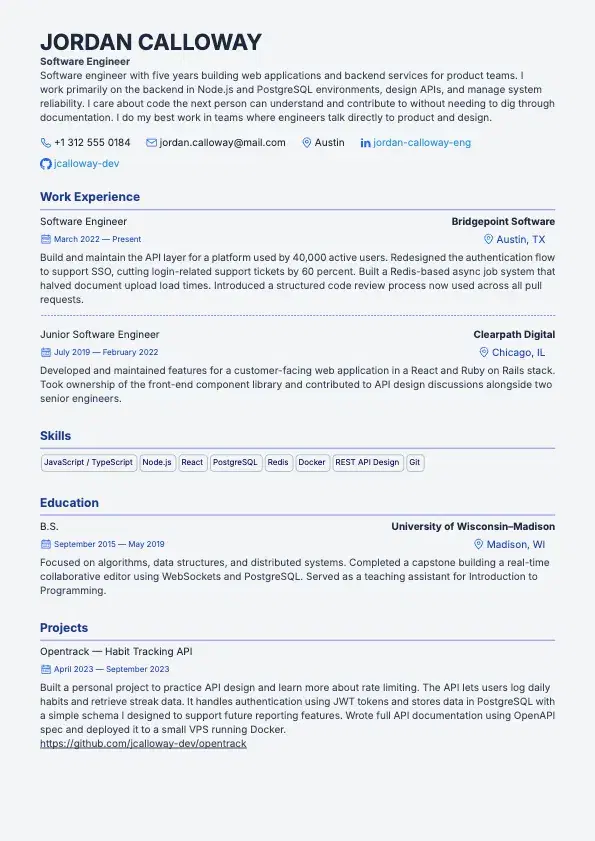
Resume Example
Software Engineer Resume
ATS-friendly example for backend engineers with Node.js, APIs, and cloud infrastructure experience.
Use This SampleCreate from Scratch- ATS-Friendly Format
- Expert-Crafted Content
- Free to Customize
Key Skills Featured in This Example
These competencies appear throughout the resume to pass ATS filters and impress hiring managers.
Why This Resume Works
The stack is named, not implied
This example lists TypeScript, Node.js, PostgreSQL, Docker, and AWS as explicit skills and then repeats them inside experience bullets where they were actually used. That redundancy is deliberate: ATS keyword matching scores both the skills section and the work history, and a hiring manager trusts a technology far more when it appears next to a concrete project ('built REST APIs in Node.js serving X requests/day') than alone in a skills list. Backend roles are filtered hard on stack match, and this resume never makes a screener guess.
Bullets are outcomes, not job descriptions
Weak engineering resumes describe responsibilities: 'responsible for maintaining APIs.' This example's bullets follow an action-system-result pattern: what was built or changed, in what technology, and what moved as a result — response times, error rates, deployment frequency, infrastructure cost. Quantified engineering bullets do two jobs at once: they prove seniority to the hiring manager and they give the AI ranking layer measurable-impact language it is explicitly tuned to reward.
The format is aggressively parseable
Single column, standard section headings (Experience, Skills, Education), reverse-chronological dates, no tables, no graphics, no two-column sidebar. Engineers are often tempted by designer templates, but multi-column layouts scramble text extraction order in many parsers, and skill-rating bars convey nothing a parser can read. This example spends its creativity on content, which is exactly where technical recruiters — and parsing software — want it.
What Hiring Teams Look For in a Software Engineer Resume
Production ownership at measurable scale
Example: Designed and operated Node.js microservices handling roughly 40M API requests per day with 99.95% uptime on AWS ECS.
Scale numbers are the fastest way for a screener to place you on the seniority ladder. 'Built APIs' could be a bootcamp project; '40M requests/day at 99.95% uptime' is a production system with on-call stakes. Even modest, honest numbers beat none — they signal you measured what you ran.
Performance and cost impact you can attribute to your work
Example: Cut p95 API latency from 850ms to 210ms by adding PostgreSQL query indexing and a Redis cache layer, reducing customer-reported timeouts by 70%.
Before-and-after metrics show engineering judgment, not just output. Hiring managers probe these numbers in interviews, so a bullet that names the technique (indexing, caching) alongside the result reads as credible and pre-answers the follow-up question.
CI/CD and deployment maturity
Example: Built a GitHub Actions CI/CD pipeline with automated integration tests, taking deployments from weekly manual releases to 15+ automated deploys per week with zero-downtime rollouts.
Deployment frequency is a proxy for engineering culture fluency. Teams practicing continuous delivery filter for candidates who have lived it — this signal tells them you will not need to be taught how modern release processes work.
Cross-boundary collaboration on real deliverables
Example: Partnered with the frontend team to redesign a REST API contract for the React checkout flow, cutting integration bugs in the release cycle by half.
Backend engineers who can negotiate API contracts with consumers are rarer than ones who can write endpoints. This signals communication skill through shipped work rather than a soft-skills adjective, which screeners uniformly ignore.
How to Write a Software Engineer Resume, Step by Step
Set up a parseable header and format
Use a single-column layout with your name, city and state, phone, email, and links to GitHub and LinkedIn in plain text at the top. Skip photos, logos, and skill-rating graphics. Use standard headings — Summary, Experience, Skills, Education — because parsers map sections by heading text, and a clever label like "My Journey" can drop your entire work history from the extracted profile.
Pro tip: Put your GitHub URL as plain text (github.com/username), not just a hyperlinked icon — icons vanish when the PDF is parsed to text.
Write a summary that states your stack and depth
Three lines maximum: years of experience, your specialization, your core stack, and one flagship achievement. For example: 'Backend engineer with 6 years building Node.js and TypeScript services on AWS; led migration to containerized microservices that cut infrastructure costs 30%.' This is the first text both the AI ranker and the recruiter read, so front-load the exact technologies from the job posting you are targeting.
Pro tip: Mirror the job title in your summary when it is honest — if the posting says 'Backend Software Engineer,' say 'backend software engineer,' not 'code craftsman.'
Build experience bullets around systems and numbers
For each role, write 3-6 bullets that each name a technology and an outcome. Cover the categories hiring managers scan for: scale (requests, users, data volume), reliability (uptime, incident reduction), performance (latency, throughput), delivery (deployment frequency, lead time), and cost (infrastructure spend). If you cannot share exact figures, use honest approximations or percentages — a defensible estimate beats a bare task description.
Pro tip: Start each bullet with a strong verb tied to engineering work — designed, built, migrated, optimized, automated — and never open two consecutive bullets with the same verb.
Structure the skills section for keyword coverage
Group skills by category: Languages (TypeScript, JavaScript, SQL), Backend (Node.js, REST APIs, PostgreSQL), Cloud and DevOps (AWS, Docker, CI/CD), Practices (Agile, Git workflows, code review). List only what you can discuss in an interview — AI screeners increasingly cross-check the skills list against where each skill appears in your experience, and orphan keywords with no supporting bullet get discounted.
Pro tip: Include both the abbreviation and the full term where both are searched — 'CI/CD (continuous integration/continuous deployment)' and 'AWS (Amazon Web Services)' cover both query forms.
Close with education, certifications, and proof of work
List your degree with institution and year; if you are self-taught or a bootcamp graduate, lead with certifications and projects instead. AWS certifications (Solutions Architect, Developer Associate) carry real filter weight for cloud-heavy roles. Add a short Projects section only if the projects are substantial — deployed, documented, with a live link or repo — because empty tutorial clones actively hurt credibility.
Pro tip: For engineers past their second job, move Education below Experience and cut coursework entirely — nobody screening a senior candidate reads it.
How Much Does a Software Engineer Make?
Low
$79,850
per year (US)
Median
$133,080
per year (US)
High
$211,450
per year (US)
The wide range reflects seniority, location, and industry: entry-level engineers in lower-cost regions sit near the bottom, while senior and staff engineers at major tech and finance companies in hub metros — often with equity on top of base — populate the top decile. Backend and cloud infrastructure specializations tend to price above the median.
Salary data based on U.S. Bureau of Labor Statistics, May 2024 Occupational Employment and Wage Statistics for Software Developers (10th percentile, median, and 90th percentile annual wages).
Key Takeaways
A software engineer resume wins by being specific where others are vague: name the stack, quantify the systems, and format for machines without boring the humans. Keep it to one page under 10 years of experience, mirror the language of each posting you target, and make every bullet answer the question a hiring manager is silently asking — what did this person build, at what scale, and what changed because of it? The candidates who advance in 2026 are not the ones with the longest skill lists; they are the ones whose resumes read like a credible engineering log of shipped, measured work.
Software Engineer Resume FAQs
How long should a software engineer resume be?
One page for under roughly 10 years of experience; two pages only if you have senior-level depth that genuinely fills them. Recruiters spend well under a minute on the first pass, so a tight single page of quantified bullets outperforms two pages of diluted ones. Cut early-career roles to one or two lines once you have stronger recent work.
Should I include a GitHub link on my resume?
Yes, if the profile shows real work — deployed projects, meaningful commits, or open-source contributions. An empty or tutorial-only GitHub is worse than none, because reviewers who click through and find nothing downgrade the rest of the resume. Put the URL in plain text in your header so parsers capture it.
How do I get a software engineer resume past ATS screening?
Use a single-column layout with standard section headings, save as PDF with selectable text, and include the exact technology keywords from the job posting in both your skills section and experience bullets. Avoid tables, text boxes, and graphics, which can scramble parsing order. Matching the posting language matters more than any formatting trick.
How many skills should I list on a software engineer resume?
Around 10-15, grouped by category (languages, backend, cloud, practices). Every listed skill should survive an interview question and ideally appear in at least one experience bullet. Long undifferentiated lists of 30+ technologies read as padding and dilute the keywords that actually match the role.
Should I put personal projects on my resume?
Only if you are early-career or changing stacks, and only projects with substance: deployed, documented, and solving a real problem. One or two strong projects with a live link and a quantified detail beat five tutorial clones. Engineers with several years of production experience should use the space for work bullets instead.
Do I need a degree to get hired as a software engineer?
No — many companies dropped hard degree requirements, though some large enterprises and visa-sponsored roles still filter on them. Without a degree, compensate with shipped work: production experience, certifications like AWS Developer Associate, and a portfolio that proves the skills directly. Lead your Education section with certifications rather than leaving it empty.
How do I quantify my work if I do not have access to metrics?
Use defensible approximations: team size, number of services owned, request volume order-of-magnitude, release cadence before and after your changes. Frame estimates honestly ("roughly," "over") and be ready to explain how you derived them. A reasoned estimate is standard practice; a bullet with no measure at all is the real risk.
Should my resume be different for backend vs. full-stack roles?
Yes — reorder, do not rewrite. For backend roles, lead with APIs, databases, and infrastructure; for full-stack, surface React or frontend work into your summary and top bullets. The underlying experience is the same, but the first five lines determine how a screener categorizes you, so make them match the posting.
Is it okay to use AI to write my software engineer resume?
Use it as an editor, not an author. AI tools are good at tightening phrasing and suggesting structure, but generic AI output is now easy for recruiters to spot and lacks the specific systems and numbers only you know. Tools like Resunote help most when you supply the real projects and metrics and let the software handle structure and ATS formatting.
How should I explain a layoff or employment gap on an engineering resume?
Do not explain it on the resume itself — dates speak for themselves, and layoffs in 2023-2025 carry little stigma given how widespread they were. If the gap exceeds six months, one line noting freelance work, open-source contributions, or upskilling (with specifics) neutralizes it. Save any fuller explanation for the cover letter or interview.
Turn This Example Into Your Resume
Use this sample as your starting point. Customize it in minutes, export as a PDF, and apply with confidence.